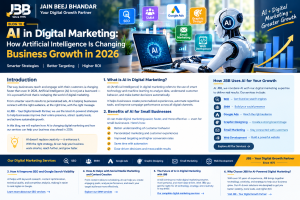
AI in Digital Marketing: How Artificial Intelligence Is Changing Business Growth in 2026
The digital world is changing rapidly, and AI in digital marketing is becoming an important part of how businesses attract customers, understand their audiences, and improve their online presence. From intelligent keyword research to personalised advertising, Artificial Intelligence (AI) is helping marketers work more efficiently and make better-informed decisions.
In 2026, businesses no longer need to rely only on guesswork to plan their marketing activities. AI tools can help analyse data, identify patterns, generate content ideas, support customer communication, and improve campaign planning. However, real success still depends on human creativity, a clear strategy, accurate information, and an understanding of customer needs.
At JBB – Your Digital Growth Partner, we believe digital growth comes from combining smart technology with practical marketing expertise. Our goal is to help businesses strengthen their online presence, reach relevant audiences, and build meaningful customer relationships through effective digital marketing.
In this article, we will explore what AI in digital marketing means, how it benefits small businesses, how it supports SEO and social media marketing, and what the future may hold.
1. What Is AI in Digital Marketing?
AI in digital marketing refers to using artificial intelligence technologies to support marketing tasks such as analysing customer data, identifying trends, creating content ideas, personalising communication, and improving campaign decisions.
AI systems can process large amounts of information and help marketers discover patterns that may otherwise take considerable time to identify. Depending on the tool, they can also assist with writing drafts, generating visual concepts, answering common customer questions, and evaluating campaign performance.
For example, a business may use AI to:
- Research relevant SEO keywords and search intent.
- Generate ideas for blog articles and social media posts.
- Analyse advertising campaign performance.
- Personalise suitable email marketing messages.
- Develop initial concepts for marketing graphics.
- Organise customer enquiries and frequently asked questions.
AI does not replace every marketing task or guarantee better results. Its value depends on how effectively it is used, whether its output is accurate, and how well it supports the business’s objectives.
The best approach is to treat AI as a marketing assistant, not a replacement for human judgement. People still need to review content, protect customer information, verify claims, and make strategic decisions.Continue reading