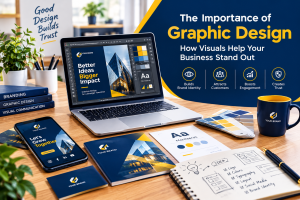
Importance of Graphic Design: How Visuals Help Your Business Stand Out
Every day, people come across hundreds of advertisements, social media posts, websites, and promotional messages. With so much information competing for their attention, businesses need more than words to communicate effectively. They need visuals that capture attention, express their identity, and make their message easy to understand.
This is where graphic design becomes important. It combines colours, typography, images, layouts, and creative ideas to communicate a message visually. Whether a business is launching a new product, promoting a service, or building its online presence, good design can help it present itself more professionally.
For businesses that want to grow in a competitive market, graphic design is not simply decoration. It is a practical way to communicate value, create recognition, and build a consistent brand identity.
1. Creates a Strong First Impression
Before customers read your company’s complete story, they often notice its logo, website appearance, advertisements, or social media creatives. These visual elements help shape their initial impression of your business.
A carefully designed graphic can make information feel organised, professional, and easier to approach. On the other hand, inconsistent colours, difficult-to-read text, and poorly arranged elements may distract people from the message.
Why it matters: A professional visual presentation helps your business introduce itself clearly and gives potential customers a better starting point for understanding your brand.
2. Builds Brand Recognition
Imagine seeing the same colours, logo, typography, and design style across a company’s website, advertisements, packaging, and social media accounts. Over time, these repeated visual elements can help people recognise the brand more easily.
Graphic design gives businesses a way to establish a recognisable visual identity. Consistency matters because customers should be able to connect different marketing materials with the same business.
To strengthen your brand recognition:
- Use a consistent colour palette.
- Maintain a clear and recognisable logo.
- Choose fonts that suit your brand personality.
- Keep layouts and visual styles consistent across platforms.
- Create simple brand guidelines for future designs.
The aim is not to make every design identical. It is to ensure that every design feels like it belongs to the same brand.
3. Makes Marketing Messages Easier to Understand
Some ideas are difficult to explain through long paragraphs alone. A well-designed infographic, illustration, chart, or visual comparison can present complex information in a more accessible format.
For example, a digital marketing agency could use an infographic to explain the stages of a marketing campaign. A retail business might use a promotional graphic to highlight a product’s key features, price, and offer.
Effective graphic design helps organise information according to importance. Headlines attract attention, supporting text adds context, and visual elements guide the reader through the message.
When designing marketing material, focus on one main message at a time. Too many competing elements can make even a beautiful design confusing.
4. Supports Social Media Engagement
Social media moves quickly. Users scroll through feeds filled with videos, photographs, advertisements, and updates from different accounts. Relevant, well-planned visuals can help a business communicate its message in a format suited to the platform.
Graphic design can support a variety of social media content, including:
- Educational posts that explain useful concepts.
- Promotional creatives that highlight products or services.
- Carousels that break a topic into manageable steps.
- Event announcements and seasonal campaigns.
- Branded templates that keep regular posts consistent.
However, attractive visuals alone cannot guarantee engagement. Content also needs to be relevant, useful, timely, and appropriate for its audience.
For a stronger social media presence, combine thoughtful design with a clear content strategy. Learn more about JBB’s Social Media Marketing services.
5. Helps Build Customer Confidence
People often use visual cues to form opinions about a business. A consistent and well-organised presentation can make a company appear more attentive to detail and serious about its communication.
Consider a business proposal with clear headings, readable charts, balanced spacing, and consistent branding. It is easier to follow than a document crowded with unrelated fonts, uneven formatting, and unnecessary decoration.
Graphic design can support customer confidence through:
- Professional business presentations.
- Consistent digital advertisements.
- Clear service brochures and promotional materials.
- Readable website graphics.
- Well-organised product and service information.
Design cannot replace reliable service or honest communication, but it can help a business present those qualities more clearly.
6. Gives Your Business a Competitive Identity
In a crowded market, businesses may offer similar products or services. Their visual presentation can help communicate what makes each brand different.
A playful design style may suit a children’s brand, while a minimal and structured style may better suit a professional consultancy. The right direction depends on the audience, industry, brand personality, and message.
Instead of copying a competitor’s graphics, identify what makes your business distinctive. Your designs should communicate your own strengths and values.
A useful principle: Design for your audience, not just for personal preference. A visual style is most effective when it fits both the brand and the people it wants to reach.
7. Strengthens Your Website and Digital Marketing
Graphic design and web development work together to create a more complete online experience. Website banners, icons, illustrations, service graphics, and promotional visuals can make information easier to navigate and understand.
The key is balance. Graphics should support the website’s purpose rather than slow it down or compete with important information.
For better results, businesses should use appropriately sized images, readable text, consistent colours, and layouts that work on mobile devices. Important information should remain accessible even when images are not displayed.
Graphic design can also support campaigns across other digital channels. For example, a business may use a consistent visual theme for its website landing page, Google Ads creative, and social media promotion.
Explore JBB’s Web Development services and Google Ads services to see how design fits into a broader digital marketing approach.
8. Makes Promotional Campaigns More Memorable
A promotion needs to communicate its purpose quickly. Customers should be able to identify what is being offered, why it may be relevant to them, and what action they can take.
Good promotional design establishes a clear visual hierarchy. The main message receives attention first, supporting information follows, and the call to action is easy to locate.
For instance, a festival offer graphic could use a relevant visual theme, a prominent offer, clear terms, and a readable contact or shopping link. Decorative elements should enhance the message rather than hide essential details.
Before publishing a promotional design, check that the offer is accurate, the text is readable, and the next step is clear.
9. What Makes Graphic Design Effective?
Effective design is not measured only by how attractive it looks. It should also fulfil the purpose for which it was created.
Here are five qualities worth prioritising:
- Clarity: The audience can understand the main message quickly.
- Consistency: Colours, fonts, and visual elements support the brand identity.
- Relevance: Images and design choices suit the audience and context.
- Readability: Text is easy to read across the intended screen or format.
- Purpose: Every important element contributes to the communication goal.
A design can be visually impressive and still fail if people cannot understand its message. Always evaluate the result against the objective.
How JBB Approaches Graphic Designing
At JBB – Your Digital Growth Partner, we recognise that every business needs a visual identity that communicates its message clearly and consistently. Graphic design should connect creativity with a practical purpose, whether that means introducing a brand, promoting a service, or communicating with customers online.
Our graphic designing service focuses on creating visuals that suit your brand and marketing needs. From social media creatives to promotional graphics, the goal is to help businesses present their messages professionally across relevant digital channels.
We believe strong visual communication starts with understanding the business, its audience, and the purpose behind each design.
Explore JBB’s Graphic Designing services to learn more.
Frequently Asked Questions
1. What is graphic design?
Graphic design is the practice of communicating ideas and information through visual elements such as typography, colours, images, illustrations, and layouts. It is used in branding, advertising, websites, social media, and many other forms of communication.
2. Why is graphic design important for businesses?
Graphic design helps businesses communicate their messages, create a consistent visual identity, present information clearly, and produce professional marketing materials. Its effectiveness depends on how well the design serves the audience and business objective.
3. Can graphic design help build brand recognition?
Yes. Consistent use of logos, colours, typography, and visual styles can make a brand easier to recognise across different platforms and marketing materials.
4. Is graphic design important for social media marketing?
Yes. Graphic design helps businesses create organised, platform-appropriate content for promotions, educational posts, announcements, and other social media communications. It works best when combined with relevant content and a clear strategy.
5. What is the difference between graphic design and web design?
Graphic design primarily focuses on visual communication, including layouts, typography, images, and branding. Web design focuses on how a website looks and how visitors interact with its pages. The two fields overlap, particularly when creating website graphics and visual interfaces.
6. How can a small business get started with graphic design?
Start by defining your audience, brand personality, preferred colours, and communication goals. Create a consistent logo and visual style, then apply them across essential materials such as social media posts, brochures, advertisements, and your website.
Conclusion
Graphic design helps businesses turn ideas into visual messages that people can recognise, understand, and remember. It contributes to brand identity, marketing communication, website presentation, and the way customers perceive a business.
The best design is not necessarily the most complicated or colourful. It is the design that communicates the right message to the right audience with clarity and purpose.
If your business wants to strengthen its visual identity, begin with consistency, understand your audience, and make every graphic serve a clear objective.
JBB – Your Digital Growth Partner | Since 1975