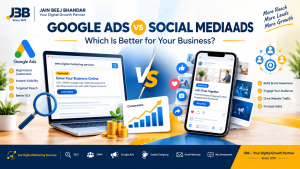
Google Ads vs Social Media Ads: Which Is Better for Your Business?
Google Ads vs social media ads is an important comparison for businesses that want to attract more customers, generate quality leads, increase sales, and grow online. Both advertising methods can help businesses reach potential customers, but they work in different ways.
Google Ads can connect your business with people who are actively searching for products or services. Social media advertising can introduce your brand to relevant audiences, encourage engagement, and create interest before customers are ready to buy.
So, which option is right for your business? Should you invest in Google Ads, social media ads, or both?
At JBB – Your Digital Growth Partner, we believe that effective digital marketing begins with understanding your business goals, your customers, and the results you want to achieve. In this guide, we will compare both advertising channels, explain their benefits, and help you choose a strategy that makes sense for your business.
What Are Google Ads?
Google Ads is an online advertising platform that allows businesses to promote their products and services across Google’s advertising network. Depending on the campaign type, ads can appear in Google Search results, on relevant websites, on YouTube, and across other supported placements.
One of the biggest advantages of Google Ads advertising is that Search campaigns can reach people when they are actively looking for a solution.
For example, someone searching for “digital marketing agency near me” may already be interested in hiring a service provider. A relevant search ad can help your business appear when that potential customer is looking for options.
Key Benefits of Google Ads
- High purchase intent: Reach people searching for specific products, services, or solutions.
- Faster visibility: Eligible ads can appear in relevant search results after a campaign is approved and begins serving.
- Keyword targeting: Select search terms related to your business and customer needs.
- Budget control: Set campaign budgets and manage your advertising spend.
- Conversion tracking: Measure valuable actions such as form submissions, calls, purchases, or enquiries when tracking is configured correctly.
- Campaign optimisation: Use performance data to improve targeting, ads, landing pages, and bidding strategies.
For businesses looking to attract customers who are already searching for their services, Google Ads can be a powerful lead-generation channel.
Explore JBB Google Ads Services to learn how a targeted advertising strategy can support your business goals.
What Are Social Media Ads?
Social media advertising involves promoting your business through paid campaigns on platforms such as Facebook, Instagram, LinkedIn, and other supported social networks.
Unlike search advertising, which often responds to an existing search, social media ads can reach people based on available audience signals, interests, demographics, behaviours, engagement, and campaign objectives.
For example, a clothing business can use visual ads to introduce a new collection to relevant audiences. A restaurant can promote its menu, while a service business can use informative videos and customer-focused creatives to generate enquiries.
Key Benefits of Social Media Ads
- Brand awareness: Introduce your business to people who may not know about it yet.
- Audience targeting: Reach relevant audience groups using available targeting options.
- Visual storytelling: Use images, videos, carousels, and other creative formats.
- Customer engagement: Encourage people to interact with your content and learn about your brand.
- Retargeting opportunities: Reach eligible audiences who previously interacted with your website or business, subject to platform settings and privacy requirements.
- Lead and sales campaigns: Encourage enquiries, website visits, product purchases, or other campaign-specific actions.
Social media ads help businesses build awareness, create interest, and encourage potential customers to take the next step.
To strengthen your overall social presence, explore JBB Social Media Marketing (SMM) for support with your social media strategy and brand communication.
Google Ads vs Social Media Ads: Key Differences
The main difference in Google Ads vs social media ads is how each channel reaches potential customers. Search advertising can respond to a customer’s immediate search intent, while social advertising can help create awareness and interest among selected audiences.
| Comparison | Google Ads | Social Media Ads |
|---|---|---|
| Main opportunity | Reach people searching for solutions | Reach relevant audiences and create interest |
| Customer intent | Often stronger for active search demand | Can reach people before they begin searching |
| Targeting | Keywords, location, language, audiences, and campaign settings | Available audience signals, interests, demographics, behaviours, and engagement |
| Common strengths | Search visibility, enquiries, and demand capture | Awareness, engagement, discovery, and visual promotion |
| Creative formats | Search text ads, image ads, video ads, and other formats depending on campaign type | Images, videos, carousels, stories, and other supported formats |
| Budget | Flexible, with costs depending on competition, targeting, and campaign setup | Flexible, with costs depending on audience, creative, competition, and campaign setup |
| Measurement | Conversions, calls, purchases, cost per lead, and other tracked actions | Leads, purchases, engagement, website actions, and other tracked actions |
| Best suited to | Businesses with customers actively searching for their services | Businesses building awareness, showcasing products, or generating demand |
Important: Neither platform guarantees low costs, high conversions, or profitable results. Performance depends on your offer, audience, competition, landing page, creative quality, tracking, and campaign management.
1. Customer Intent: Who Is More Ready to Buy?
Customer intent is one of the most important factors when choosing between Google Ads vs social media ads.
Google Ads: Reach Customers Who Are Searching
Imagine someone searches for “website development company in India.” This person is actively looking for a solution and may be comparing providers.
A relevant Google Search campaign can help your business reach that person at the right moment.
This makes Google Ads for lead generation particularly useful when customers already know what they need and are searching for a provider.
Social Media Ads: Create Demand Before Customers Search
Now imagine a business owner scrolling through Instagram. They are not actively searching for a marketing agency, but an engaging advertisement explaining how a better website can improve customer enquiries might capture their attention.
That is where social media advertising can be valuable: it helps introduce a problem, demonstrate a solution, and encourage people to explore your business.
Which wins? Google Ads often has an advantage when a customer is actively searching. Social media ads can be stronger for discovery and awareness. The right choice depends on how your customers make buying decisions.
2. Audience Targeting: Which Reaches the Right People?
Both advertising channels offer targeting options, but their approaches differ.
With Google Ads targeting, advertisers can use relevant keywords, locations, languages, audience signals, and other settings depending on the campaign type. Search campaigns are particularly useful for connecting an ad with a relevant search query.
With social media ad targeting, businesses can reach audiences using supported demographic, interest, behaviour, engagement, and other available signals. The exact options depend on the platform and campaign objective.
For example:
- A local service provider may focus on people searching for a specific service in a selected city.
- A fashion brand may use visual ads to introduce a new product collection to a relevant audience.
- A B2B company may use professional audience targeting on a suitable platform.
- An established website may use eligible remarketing audiences to reconnect with previous visitors.
The best approach is not to target everyone. It is to reach the most relevant audience for your offer while respecting platform policies and privacy requirements.
3. Budget: Which Advertising Method Costs Less?
A common question businesses ask is: Are Google Ads cheaper than social media ads?
There is no universal answer. Both channels can be used with different budgets, but costs depend on competition, audience, location, campaign objective, creative quality, and bidding strategy.
In Google Search campaigns, competitive keywords may have high costs per click. In social media campaigns, results can vary according to audience demand, ad quality, placements, and the action you want people to take.
Instead of choosing a platform simply because its clicks appear cheaper, consider the value of the customers it generates.
For example, imagine two campaigns:
- Campaign A spends ₹10,000 and generates 20 enquiries.
- Campaign B spends ₹10,000 and generates 10 enquiries.
Campaign A has a lower cost per enquiry. However, if Campaign B produces more qualified leads or more paying customers, it could deliver better business value.
This is why cost per lead, lead quality, conversion rate, customer acquisition cost, and return on ad spend are more useful decision-making metrics than clicks alone.
Start with a manageable budget, set a clear goal, and use actual campaign data to decide where additional spending makes sense.
4. Campaign Goals: What Do You Want to Achieve?
Your business objective should guide your advertising strategy.
Choose Google Ads When You Want To:
- Attract people searching for your services.
- Generate enquiries for high-intent keywords.
- Promote services people already know they need.
- Increase relevant website traffic from search.
- Measure calls, purchases, and lead submissions.
- Reach customers looking for a solution in a specific location.
Choose Social Media Ads When You Want To:
- Introduce your business to new audiences.
- Promote products through engaging visuals and videos.
- Build awareness for a new brand or offer.
- Encourage engagement with your content.
- Generate leads through supported lead-generation formats.
- Retarget eligible audiences who have interacted with your business.
A campaign should have one clear primary objective. Trying to achieve awareness, engagement, sales, and leads simultaneously without a defined structure can make it harder to evaluate performance.
5. How to Measure Conversions and Advertising ROI
The real success of Google Ads vs social media ads should be judged by meaningful business results, not just how many people see or click an advertisement.
A conversion is a valuable action that you define for your business. It might be a completed enquiry form, a qualified phone call, an online purchase, a booking, or another action that matters to your goals.
Important Metrics to Track
Click-through rate (CTR): The percentage of ad impressions that result in clicks. It can help you understand how well an ad attracts attention.
Conversion rate: The percentage of relevant visits or interactions that result in a defined conversion.
Cost per lead (CPL): Advertising spend divided by the number of leads generated.
Customer acquisition cost (CAC): The cost of acquiring a paying customer, including the costs included in your calculation.
Return on ad spend (ROAS): Attributed revenue divided by advertising spend. It is useful for sales campaigns when revenue tracking is configured correctly, but it does not account for every business cost.
Lead quality: Whether the enquiries are relevant, qualified, and likely to become customers.
A Simple Example
Suppose you spend ₹15,000 on a campaign and generate 30 enquiries.
Your cost per lead is:
₹15,000 ÷ 30 = ₹500 per lead
Now suppose only 5 of those enquiries become customers. Your advertising cost per acquired customer is ₹3,000, before considering agency fees, production costs, and other expenses.
This example shows why tracking conversions and lead quality matters. A campaign that generates many enquiries is not necessarily the most profitable campaign.
To measure results reliably, configure conversion tracking, test important actions, use consistent reporting, and compare results over a meaningful period. Account for differences in platform attribution and avoid counting the same customer action more than once.
6. Why Your Website Matters for Both Advertising Channels
Even a well-targeted advertisement can struggle if the page visitors land on is slow, confusing, difficult to use on mobile, or missing a clear next step.
Your website should explain your offer, establish trust, answer common questions, and make it easy for visitors to contact you or purchase.
For better results, consider these improvements:
- Create a dedicated landing page that matches the advertisement.
- Explain the benefits of your product or service clearly.
- Use a prominent call-to-action.
- Make forms short and easy to complete.
- Ensure the website works well on mobile devices.
- Display accurate contact details and genuine trust signals.
- Measure completed forms, calls, and purchases instead of relying only on traffic.
If your website needs a stronger foundation, explore JBB Web Development Services.
You can also support your campaigns with JBB Search Engine Optimisation (SEO) to work toward stronger organic search visibility over time. Paid advertising and SEO serve different purposes, but they can support a broader digital growth strategy.
7. Can Google Ads and Social Media Ads Work Together?
Yes. For many businesses, using both channels can create a more complete customer journey.
Consider a simple example:
- A potential customer discovers your brand through a social media advertisement.
- They watch your video, visit your website, or learn more about your services.
- Later, they search Google for the service they need.
- A relevant search advertisement helps them find your business again.
- They visit your landing page, enquire, and potentially become a customer.
This journey is only an example; not every customer follows the same path. Results depend on campaign setup, audience behaviour, available targeting, consent, and tracking.
The key is to give each channel a clear role rather than running two campaigns without coordination.
For instance, Google Search may focus on capturing existing demand, while social media campaigns build awareness and showcase your offer. You can then compare the quality and cost of the customers each channel contributes.
A connected strategy may also use JBB Graphic Designing Services to create consistent visual communication and JBB Email Marketing Services to nurture subscribers and suitable leads who have agreed to receive marketing communications.
8. Why Choose JBB for Digital Marketing?
Choosing the right advertising platform is only one part of growing your business. You also need a clear strategy, relevant messaging, a suitable landing page, accurate tracking, and regular performance reviews.
JBB – Your Digital Growth Partner, Since 1975 aims to help businesses build a stronger online presence through a coordinated range of digital marketing services.
With the right plan, your business can work toward reaching relevant audiences, generating more meaningful enquiries, improving its online presentation, and measuring marketing performance more clearly.
How JBB Can Support Your Growth
Google Ads: Develop campaigns around relevant searches, business objectives, and conversion goals.
Social Media Marketing (SMM): Build a more consistent social presence and communicate with relevant audiences.
SEO: Improve the foundations of organic search visibility through relevant content and website optimisation.
Graphic Designing: Create clear, professional visuals that support your brand message and advertising campaigns.
Web Development: Build or improve a website that communicates your offer and guides visitors toward action.
Email Marketing: Maintain customer relationships and share relevant updates with people who have opted in.
Explore all the services at JBB – Your Digital Growth Partner and choose the support that fits your business needs.
The goal is not to spend more on advertising without a plan. It is to make informed decisions, test what works, and invest in activities that support your business objectives. Results will vary by industry, budget, competition, and campaign execution, so no agency or advertising platform can guarantee a specific outcome.
Final Verdict: Google Ads vs Social Media Ads
So, Google Ads vs social media ads: which is better for your business?
Choose Google Ads when your customers are actively searching for a solution and you want to capture relevant demand. Choose social media ads when you want to introduce your brand, showcase your products, create interest, or engage a relevant audience.
If your business needs both immediate visibility and long-term brand development, a carefully planned combination may be worth testing.
Before investing, identify your ideal customer, define a realistic budget, choose one primary campaign goal, set up conversion tracking, and evaluate the quality of the results.
With a thoughtful strategy and the right support from JBB – Your Digital Growth Partner, your business can make more informed digital marketing decisions and work toward sustainable online growth.
Ready to grow your business online? Explore JBB Google Ads Services or visit our website to learn more.
Frequently Asked Questions (FAQs)
1. What is the main difference between Google Ads and social media ads?
Google Ads can reach people searching for particular products or services, while social media ads can reach relevant audiences based on available audience signals and encourage discovery, awareness, and engagement.
2. Are Google Ads better than social media ads for lead generation?
It depends on the business and its customers. Google Search ads can work well when people are actively searching for a service. Social media ads can generate leads by introducing an offer to relevant audiences. Track qualified leads and customer acquisition costs to compare performance.
3. Which advertising platform is best for small businesses?
Small businesses should select a platform based on their target audience, offer, location, budget, and objectives. A local service business may benefit from high-intent search campaigns, while a visual product brand may find social media advertising useful. Test and measure before expanding the budget.
4. How much budget do I need for Google Ads or social media ads?
There is no fixed budget suitable for every business. Start with an amount you can afford to test, estimate your potential cost per lead or sale, and review the results. Actual costs vary by industry, audience, competition, and campaign settings.
5. Can I run Google Ads and social media ads at the same time?
Yes. They can serve different purposes within one marketing strategy. For example, social media ads may introduce your brand, while Google Search ads help capture people actively searching for your services. Make sure both campaigns have clear goals and reliable conversion tracking.
6. How do I know whether my advertising campaign is successful?
Measure the results that matter to your business, including qualified leads, completed purchases, cost per acquisition, conversion rate, and revenue where appropriate. Impressions, likes, and clicks can provide useful context, but they should not be your only measures of success.
7. Does JBB provide Google Ads and other digital marketing services?
JBB’s website presents a range of digital marketing services, including Google Ads, SMM, SEO, graphic designing, email marketing, and web development. Visit JBB – Your Digital Growth Partner to explore the services and determine which ones suit your requirements.
JBB – Your Digital Growth Partner
Since 1975 | Building a Stronger Digital Future
Website: https://jainbeejbhandar.com/
Explore our Google Ads Services and take the next step toward a more strategic online presence.