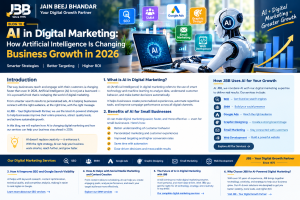
AI in Digital Marketing: How Artificial Intelligence Is Changing Business Growth in 2026
The digital world is changing rapidly, and AI in digital marketing is becoming an important part of how businesses attract customers, understand their audiences, and improve their online presence. From intelligent keyword research to personalised advertising, Artificial Intelligence (AI) is helping marketers work more efficiently and make better-informed decisions.
In 2026, businesses no longer need to rely only on guesswork to plan their marketing activities. AI tools can help analyse data, identify patterns, generate content ideas, support customer communication, and improve campaign planning. However, real success still depends on human creativity, a clear strategy, accurate information, and an understanding of customer needs.
At JBB – Your Digital Growth Partner, we believe digital growth comes from combining smart technology with practical marketing expertise. Our goal is to help businesses strengthen their online presence, reach relevant audiences, and build meaningful customer relationships through effective digital marketing.
In this article, we will explore what AI in digital marketing means, how it benefits small businesses, how it supports SEO and social media marketing, and what the future may hold.
1. What Is AI in Digital Marketing?
AI in digital marketing refers to using artificial intelligence technologies to support marketing tasks such as analysing customer data, identifying trends, creating content ideas, personalising communication, and improving campaign decisions.
AI systems can process large amounts of information and help marketers discover patterns that may otherwise take considerable time to identify. Depending on the tool, they can also assist with writing drafts, generating visual concepts, answering common customer questions, and evaluating campaign performance.
For example, a business may use AI to:
- Research relevant SEO keywords and search intent.
- Generate ideas for blog articles and social media posts.
- Analyse advertising campaign performance.
- Personalise suitable email marketing messages.
- Develop initial concepts for marketing graphics.
- Organise customer enquiries and frequently asked questions.
AI does not replace every marketing task or guarantee better results. Its value depends on how effectively it is used, whether its output is accurate, and how well it supports the business’s objectives.
The best approach is to treat AI as a marketing assistant, not a replacement for human judgement. People still need to review content, protect customer information, verify claims, and make strategic decisions.
2. Benefits of AI in Digital Marketing for Small Businesses
Small businesses often work with limited time, staff, and marketing budgets. AI marketing tools can help make certain tasks more manageable, allowing business owners and marketing teams to focus on activities that create value.
A. Save Time on Repetitive Tasks
AI can help draft captions, organise content ideas, summarise performance reports, and prepare initial email drafts. These capabilities can reduce the time spent on repetitive work.
The saved time can then be used for customer service, creative planning, and improving the overall marketing strategy.
B. Understand Customers Better
AI tools can help analyse available customer and campaign data to identify patterns in behaviour, interests, and engagement.
For example, a business may discover that certain pages receive more enquiries or that particular campaigns attract more relevant visitors. These insights can inform future marketing decisions.
Businesses should use customer information responsibly and follow applicable privacy and consent requirements.
C. Improve Marketing Personalisation
Customers respond to messages that are relevant to their needs. AI-powered personalisation can help businesses organise audiences, suggest suitable content, and tailor communication where appropriate.
For example, an online store may send product recommendations based on permitted customer activity, while a service business may create different messages for customers interested in different services.
D. Make Better-Informed Decisions
AI-assisted analytics can help marketers review campaign results, identify changes in performance, and develop ideas for improvement.
However, recommendations should always be checked against reliable data. A tool’s prediction is not a guarantee, and human review remains important.
E. Support Business Growth
By making research, planning, and reporting more efficient, AI can help businesses improve their marketing processes. The strongest results come when these efficiencies support a clear strategy and measurable goals.
For businesses that want to turn these opportunities into a practical plan, JBB – Your Digital Growth Partner offers digital marketing services designed to support different stages of online growth.
3. How AI Improves SEO and Google Search Visibility
AI in SEO is changing how marketers research keywords, understand search intent, plan useful content, and identify website improvement opportunities.
Search engine optimisation remains important because people use search engines to discover businesses, compare services, and find answers. AI can assist with SEO activities, but it does not automatically make a website rank higher on Google.
AI for Keyword Research
AI tools can help generate keyword ideas, group related search terms, and identify questions that potential customers may ask.
For example, a digital marketing business might research phrases such as:
- AI in digital marketing
- AI SEO tools
- Digital marketing for small businesses
- AI in social media marketing
- Benefits of AI in marketing
These are examples of relevant keyword ideas, not verified search-volume rankings. Before targeting a keyword, review its relevance, search intent, competition, and available search data.
AI for Content Optimisation
AI can help organise an article, suggest headings, identify missing questions, and improve readability. Marketers can use these suggestions to create content that answers customer needs more clearly.
However, publishing generic AI-generated articles without original value is not a reliable SEO strategy. Your content should provide useful explanations, practical examples, accurate information, and insights relevant to your audience.
AI for Website Analysis
Depending on the tools used, AI can assist with identifying technical issues, reviewing page content, grouping keywords, and analysing competitor information.
These insights can help marketers prioritise improvements, but technical findings should be verified before changes are made.
How JBB Supports SEO
A strong SEO strategy combines relevant content, website quality, useful internal links, technical foundations, and a clear understanding of what customers are searching for.
Explore JBB SEO Services to learn more about improving your website’s search visibility and supporting sustainable organic growth.
Remember: AI can support SEO work, but useful content and a strong website experience remain essential. No AI tool or agency can guarantee a specific Google ranking.
4. How AI Helps with Social Media Marketing and Content Creation
Social media platforms give businesses opportunities to build brand awareness, share information, connect with customers, and promote their products or services. AI in social media marketing can make planning and content development more efficient.
Generate Social Media Content Ideas
AI can help suggest post topics, campaign themes, captions, video concepts, and content calendar ideas. This is especially useful for businesses that struggle to publish consistently.
For example, a business could plan educational posts, frequently asked questions, service explanations, customer stories, and promotional campaigns.
Create More Relevant Content
Different audiences may respond to different formats and messages. AI can help adapt a core idea into a caption, short video script, carousel outline, or email draft.
The final content should still reflect your brand voice and provide something useful to the audience.
Analyse Engagement and Performance
AI-assisted tools can help review available engagement metrics, compare content performance, and identify topics worth testing again.
However, likes and views are not the same as business growth. Track meaningful outcomes such as relevant enquiries, website visits, qualified leads, and sales where possible.
Improve Social Media Campaign Planning
AI can help marketers organise campaign ideas and prepare variations for testing. Actual performance should determine which messages, formats, and audiences deserve further investment.
For businesses that want to build a stronger social presence, explore JBB Social Media Marketing (SMM).
Combining AI-assisted planning with human creativity can help businesses create more consistent, engaging, and relevant social media content.
5. AI in Google Ads: Smarter Campaign Planning
Paid advertising can help businesses reach potential customers, but campaign performance depends on targeting, competition, messaging, landing pages, and budget management.
AI in Google Ads can support certain advertising tasks through automated bidding, audience signals, creative assistance, and campaign optimisation features available within different campaign types.
For example, AI-supported advertising features may help advertisers optimise towards defined goals using campaign data. The effectiveness of these features depends on the quality of the setup, conversion tracking, available data, and the campaign objective.
How AI Can Support Google Ads
- Help develop and test relevant ad message ideas.
- Support automated bidding strategies where suitable.
- Assist with analysing campaign performance.
- Help advertisers identify opportunities for optimisation.
- Support targeting and delivery decisions through available platform features.
Automation does not remove the need for proper management. Advertisers should monitor budgets, review search terms where applicable, check conversion tracking, and ensure that advertisements lead to useful landing pages.
To explore paid advertising support, visit JBB Google Ads Services.
A well-planned campaign should focus on business outcomes such as qualified enquiries, sales, and customer acquisition costs rather than clicks alone.
6. AI in Graphic Design: Create More Effective Visual Content
Visual content influences how people perceive a brand. AI in graphic design can help generate ideas, explore layouts, create initial concepts, and speed up certain creative tasks.
For example, a business might use AI to brainstorm social media campaign concepts, develop mood boards, explore colour combinations, or prepare draft visuals for review.
However, AI-generated designs may contain incorrect text, inconsistent branding, unsuitable images, or visual errors. Every final design should be checked carefully.
Where AI Can Help with Graphic Design
- Generate early creative concepts.
- Explore different visual styles.
- Support campaign brainstorming.
- Adapt ideas for different marketing formats.
- Speed up selected design and editing tasks.
A professional visual identity still requires consistency, clear communication, and attention to detail. AI should support the creative process rather than replace quality control.
Explore JBB Graphic Designing Services to learn more about creating visual content that supports your brand identity and marketing goals.
7. AI in Email Marketing: More Relevant Customer Communication
AI in email marketing can help businesses organise content ideas, prepare subject-line variations, segment suitable audiences, and analyse campaign performance.
Instead of sending the same message to every subscriber, businesses can use appropriate data and consent-based segmentation to make emails more relevant.
Ways AI Can Support Email Marketing
- Draft email subject lines and message variations.
- Suggest content based on audience interests.
- Help organise campaign schedules.
- Analyse available engagement and conversion data.
- Support the planning of automated email journeys.
For example, a business could send a welcome email to new subscribers, educational content to interested prospects, and relevant updates to existing customers.
Email marketing should respect consent, privacy, and unsubscribe preferences. AI-generated messages also need human review to ensure that the information is accurate and appropriate.
Explore JBB Email Marketing Services to learn how structured email campaigns can support customer communication and long-term relationships.
8. Why Your Website Still Matters in an AI-Driven Marketing World
Even with advanced AI tools, your website remains an important destination for customers who want to understand your business, compare services, and take action.
A website should communicate your offer clearly, work well on mobile devices, load reliably, and make it easy for visitors to contact you or complete a purchase.
AI can help with website planning, content drafts, and certain development tasks. However, professional review is necessary to check functionality, security, accessibility, performance, and user experience.
Important Website Elements
- Clear service information and useful page headings.
- Responsive layouts for mobile, tablet, and desktop.
- Fast-loading pages and optimised images.
- Easy-to-find contact details and enquiry forms.
- Relevant calls to action.
- Accurate content and trustworthy information.
- Appropriate analytics and conversion tracking.
A strong website can support SEO, paid advertising, social media, and email marketing together.
Explore JBB Web Development Services to learn more about building a professional online presence for your business.
9. The Future of AI in Digital Marketing in 2026 and Beyond
The future of AI in digital marketing will likely involve more automation, more sophisticated data analysis, and increasingly personalised customer experiences. Businesses will continue exploring ways to use AI for research, content development, campaign planning, and customer support.
Here are several areas worth watching.
AI-Assisted Search and Discovery
Search experiences are evolving, and customers may discover businesses through traditional search results, AI-assisted answers, social platforms, and other digital channels.
Businesses should continue creating helpful, accurate, people-first content and maintaining strong technical SEO foundations rather than relying on shortcuts.
More Personalised Customer Experiences
AI may help businesses deliver more relevant content and recommendations when suitable data is available and used responsibly.
Personalisation should improve the customer experience, not make people feel monitored or overwhelmed.
Greater Marketing Automation
Businesses may automate repetitive tasks such as reporting, scheduling, and selected customer communication workflows.
Automation should be monitored to prevent inaccurate responses, poor customer experiences, and unnecessary messages.
Human Creativity Will Remain Important
AI can generate many ideas quickly, but original thinking, business knowledge, empathy, and sound judgement remain valuable.
Brands that combine technology with authentic communication can build stronger relationships than brands that publish generic content without considering their audience.
Better Measurement and Decision-Making
AI-assisted analysis can help marketers review performance and identify possible improvements. Businesses should still verify results, understand attribution limitations, and connect marketing metrics with real commercial outcomes.
The most useful approach is to stay curious, test relevant tools, and adopt technology when it provides a clear benefit.
10. Why Choose JBB for Digital Marketing?
Technology alone does not create a successful marketing strategy. Businesses need the right combination of planning, creativity, technical execution, customer understanding, and performance measurement.
JBB – Your Digital Growth Partner, Since 1975, brings together a range of digital marketing services to help businesses strengthen their online presence and work towards their growth objectives.
Whether your priority is improving search visibility, increasing social media engagement, reaching potential customers through paid campaigns, creating professional graphics, building customer relationships through email, or improving your website, the right service mix depends on your needs.
Explore JBB’s Digital Marketing Services
- SEO Services: Work towards stronger organic search visibility through relevant content and website optimisation.
- Social Media Marketing (SMM): Build a consistent social presence and connect with relevant audiences.
- Google Ads: Reach potential customers through targeted advertising campaigns.
- Graphic Designing: Communicate your brand message through professional visual content.
- Email Marketing: Nurture customer relationships through relevant, consent-based email communication.
- Web Development: Create or improve a website that represents your business and guides visitors towards action.
At JBB – Your Digital Growth Partner, our focus is on helping businesses understand their digital opportunities and choose strategies that match their goals.
We believe that effective marketing combines useful technology, clear communication, and consistent effort. While results vary according to your industry, budget, competition, and implementation, a well-planned strategy can help you make more informed decisions about your online growth.
Conclusion: Use AI to Make Your Digital Marketing Smarter
AI in digital marketing offers businesses new ways to research audiences, plan content, support advertising, improve workflows, and understand campaign performance.
From AI in SEO and AI in social media marketing to automated advertising features, email personalisation, graphic design, and website planning, the opportunities are wide-ranging. The key is to use AI thoughtfully and verify its output instead of relying on automation alone.
For small businesses, the best starting point is to identify one marketing challenge, choose a suitable tool, test it carefully, and measure whether it creates real value.
With a clear strategy and the right combination of digital marketing services, businesses can build a stronger online presence and work towards sustainable growth.
Ready to strengthen your online presence? Explore JBB – Your Digital Growth Partner and discover how our digital marketing services can support your business goals.
JBB – Your Digital Growth Partner
Since 1975 | Building a Stronger Digital Future
Frequently Asked Questions (FAQs)
1. What is AI in digital marketing?
AI in digital marketing means using artificial intelligence to support tasks such as content planning, customer data analysis, audience segmentation, advertising optimisation, and campaign reporting.
2. How does AI help small businesses with digital marketing?
AI can help small businesses save time on selected repetitive tasks, generate content ideas, analyse available data, and plan more relevant campaigns. Results depend on the tools used and how effectively they are implemented.
3. Can AI improve SEO and Google rankings?
AI can assist with keyword research, content planning, and website analysis. However, using AI does not automatically improve rankings. Websites still need useful content, strong technical foundations, and a positive user experience.
4. Can AI create social media content?
Yes. AI tools can help draft captions, suggest post ideas, outline video scripts, and plan content calendars. Human review is important to maintain accuracy, originality, brand voice, and relevance.
5. Will AI replace digital marketing professionals?
AI can automate or assist with certain tasks, but strategy, creativity, customer understanding, ethical judgement, and quality control remain important. AI is most useful when it supports skilled marketing work.
6. Which AI tools should a small business use?
The right tools depend on the task, budget, privacy requirements, and existing workflow. Start with a specific need, compare available tools, check their limitations, and measure the value they provide before committing to paid plans.
7. Does JBB provide digital marketing services?
JBB’s website features services including SEO, SMM, Google Ads, graphic designing, email marketing, and web development. Visit JBB – Your Digital Growth Partner to explore the services and find the options relevant to your business.
8. How can I start using AI in digital marketing?
Start by identifying a clear objective, such as improving content planning, understanding campaign performance, or making customer communication more efficient. Choose an appropriate tool, review its output, protect customer data, and measure the results before expanding its use.