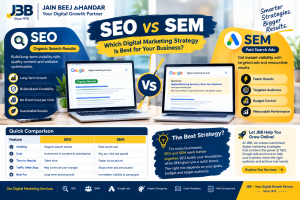
SEO vs SEM: Which Digital Marketing Strategy Is Best for Your Business?
In today’s competitive online world, having a website is only the beginning. Businesses also need a strategy to help potential customers discover their products and services online. Two important approaches that support this goal are Search Engine Optimisation (SEO) and Search Engine Marketing (SEM).
Although SEO vs SEM is often discussed as a competition, both strategies can help businesses attract relevant visitors, increase brand visibility, and generate enquiries. The main difference is how they help your business appear in search results and how the costs, timelines, and optimisation methods work.
At JBB – Your Digital Growth Partner, we believe businesses benefit from a digital marketing strategy built around their goals, audience, and budget. Our services are designed to help businesses strengthen their online presence through search visibility, advertising, social media, creative design, email marketing, and website development.
In this guide, we will explain SEO and SEM, compare their advantages and limitations, and help you understand which approach may work best for your business.
What Is SEO (Search Engine Optimisation)?
Search Engine Optimisation (SEO) is the process of improving a website so that its pages can be discovered more easily and perform better in the unpaid, or organic, search results of search engines.
The goal of SEO marketing is to help your website appear when people search for information, products, or services related to your business.
For example, if someone searches for “digital marketing agency for small businesses,” a well-optimised service page or informative blog may have an opportunity to appear in the organic results.
How SEO works
1. Keyword research: Identify the phrases your potential customers use when searching for relevant products and services.
2. On-page SEO: Improve page titles, headings, content, internal links, image alt text, and other page elements.
3. Technical SEO: Help search engines crawl and understand your website by addressing issues such as broken links, mobile usability, indexing, and page performance.
4. Helpful content: Publish useful, relevant information that answers genuine customer questions.
5. Website authority and trust: Build a credible online presence through useful content, reputable references, and a positive user experience.
At JBB, our SEO services focus on helping businesses work towards better organic search visibility through a structured optimisation strategy.
Benefits of SEO
- Long-term visibility: Well-performing pages can continue attracting organic visitors over time.
- Relevant website traffic: Helpful content can reach people searching for your products or services.
- Brand credibility: Appearing in relevant organic results can help people discover and evaluate your business.
- Content value: Blogs and service pages can answer customer questions at different stages of the buying journey.
- Support for other marketing channels: SEO improvements can complement paid campaigns, social media, and website development.
Limitations of SEO
SEO usually requires consistent work and patience. Rankings are not guaranteed, and results can be affected by competition, website quality, search engine changes, and the usefulness of your content.
SEO is therefore better understood as an ongoing investment in your website’s organic visibility rather than an instant solution.
What Is SEM (Search Engine Marketing)?
Search Engine Marketing (SEM) is commonly used in digital marketing to describe paid search advertising that helps businesses appear in sponsored search results. In some contexts, SEM is also used as a broader term for search marketing that includes SEO and paid search.
For this article, SEM refers to paid search advertising, such as campaigns run through Google Ads.
For example, a business offering website development can run a paid search campaign targeting relevant queries from people looking for website services. Depending on the campaign setup, its advertisement may appear in sponsored search results.
How SEM works
1. Choose campaign goals: Decide whether the campaign should generate enquiries, sales, calls, or another measurable action.
2. Research relevant keywords: Identify search terms that align with your offer and customer intent.
3. Create advertisements: Write clear headlines and descriptions that explain your service and encourage relevant action.
4. Set a budget and bidding strategy: Choose suitable campaign settings and control advertising expenditure.
5. Measure and optimise: Review clicks, conversions, cost per conversion, and lead quality to identify opportunities for improvement.
Benefits of SEM
- Faster visibility: Eligible ads can begin appearing after a campaign is approved and becomes active.
- Budget control: Advertisers can set campaign budgets and adjust spending.
- Targeting options: Campaign settings can help focus advertising on relevant locations, searches, and audiences.
- Measurable performance: Reports can show how advertisements perform against selected goals.
- Flexible testing: Businesses can test different messages, offers, and landing pages.
Limitations of SEM
Paid search requires an advertising budget. Costs vary depending on competition, industry, targeting, and campaign quality. Traffic from paid ads generally reduces or stops when the campaign is paused, and spending does not guarantee leads or sales.
Successful SEM also requires relevant advertisements, appropriate targeting, reliable conversion tracking, and a landing page that makes it easy for visitors to take the next step.
SEO vs SEM: What’s the Difference?
Both SEO and SEM can help businesses reach people through search engines, but they differ in how visibility is earned, how costs are incurred, and how quickly campaigns may produce traffic.
| Comparison factor | SEO | SEM (paid search) |
|---|---|---|
| Main approach | Improve organic search visibility | Pay to show advertisements in eligible search results |
| Cost model | Investment in content, optimisation, expertise, and website improvements | Advertising spend plus campaign management costs, where applicable |
| Time to results | Usually takes time and ongoing effort | Ads may begin appearing once approved and active |
| Visibility | Organic search results | Sponsored search placements |
| Traffic after spending stops | Existing rankings may continue, but can change over time | Paid traffic generally stops when ads are paused |
| Budget control | No direct payment for each organic click, but SEO work has costs | Campaign budgets and bidding settings help manage ad spend |
| Long-term value | Can build lasting organic visibility | Can support immediate or time-sensitive campaign objectives |
| Testing offers | Content and page changes take time to evaluate | Ad and landing-page variations can often be tested more directly |
| Best suited for | Building organic visibility and useful search content | Reaching relevant searchers through paid advertising |
| Main challenge | Competition, time, and changing search results | Ongoing spend, competition, and campaign efficiency |
Important: Neither approach guarantees top rankings, conversions, or business growth. Results depend on the market, strategy, implementation, website experience, and offer.
SEO vs SEM: Which One Gives Better Results?
The answer depends on what your business needs right now.
Choose SEO if your goal is long-term organic growth
SEO may be a good fit if you want to improve organic visibility, answer customer questions, attract relevant website visitors, and build a library of useful service pages and articles.
For example, a business that wants to attract customers searching for its services over time may benefit from investing in technical improvements, helpful content, local search visibility, and keyword-focused service pages.
Explore JBB’s SEO services to learn more about building an organic search strategy.
Choose SEM if you want to reach searchers through paid ads
Paid search may be useful when you want to promote a service, test a new offer, generate enquiries within a defined period, or reach people searching for particular products and services.
For example, a business launching a new service may use Google Ads to reach relevant searchers while it continues building organic visibility.
Learn more about JBB’s Google Ads services.
Choose both if you want a coordinated search strategy
For many businesses, SEO and SEM work better as complementary strategies rather than competing options.
SEO can help build organic visibility over time, while paid search can provide an additional way to reach relevant searchers. Campaign data may also help inform keyword and landing-page decisions, although paid search does not directly guarantee improved organic rankings.
A coordinated strategy can help businesses address both immediate advertising objectives and longer-term visibility goals.
Why Combining SEO and SEM Can Be a Smart Choice
Using both channels can help your business approach search marketing from different directions.
1. Reach more relevant searchers: Organic listings and paid ads can provide different opportunities for visibility across relevant search results.
2. Learn from campaign data: Paid search reports can help identify queries, messages, and landing pages worth investigating further for organic content.
3. Support different customer journeys: Some people need quick information, while others research a business over several visits. SEO content and paid advertising can support different stages of that journey.
4. Test messaging: Paid ad variations can help you evaluate which value propositions attract attention. Use those findings as one input when improving service-page messaging.
5. Build a stronger digital presence: Search marketing can work alongside an effective website, social media activity, and useful content to create a more consistent customer experience.
For a more complete approach, businesses can combine search marketing with Social Media Marketing (SMM), Graphic Designing, Email Marketing, and Web Development.
How JBB Helps Businesses Grow with Digital Marketing
Choosing the right marketing channels is important, but effective implementation matters just as much. Businesses need a strategy that reflects their goals, audience, available resources, and competitive environment.
At JBB – Your Digital Growth Partner, our digital marketing services can help businesses develop a more structured online presence. We aim to connect the right marketing activities with clear objectives, relevant messaging, and ongoing performance evaluation.
Our digital marketing services
SEO: Our SEO service helps businesses work on organic search visibility, website optimisation, and useful content.
Google Ads: Through Google Ads, businesses can explore paid search campaigns designed around relevant keywords, campaign goals, and measurable actions.
Social Media Marketing: Our SMM service supports consistent social communication, audience engagement, and brand visibility.
Graphic Designing: Our graphic design service helps businesses communicate their message through professional marketing visuals.
Email Marketing: Our email marketing service can support customer communication, relationship building, and repeat engagement.
Web Development: Our web development service focuses on creating websites that present your business professionally and provide visitors with a clear user experience.
Why consider JBB for your digital growth?
- Connected services: Access multiple digital marketing services through one provider.
- Goal-focused planning: Choose activities based on your business objectives rather than following trends without a clear purpose.
- Measurable thinking: Use relevant performance indicators to evaluate progress and make informed decisions.
- Consistent brand communication: Coordinate your website, advertisements, content, and visual identity.
- A long-term perspective: Build a digital marketing plan that can be reviewed and refined as your business develops.
We believe JBB can be a strong digital marketing partner for businesses that value a coordinated approach. The best provider for any business is one that understands its needs, communicates clearly, and can demonstrate the value of its work.
Explore the JBB website to learn about our services and decide which options best fit your goals.
How to Choose the Right SEO and SEM Strategy
Before investing, ask yourself these questions:
What is your main objective? If you want to build organic visibility over time, SEO may be a priority. If you want to promote an offer through paid search, SEM may be useful.
How quickly do you need visibility? Paid ads can begin generating visibility sooner once active, while SEO generally requires ongoing work.
What budget can you sustain? Paid campaigns need advertising spend, while SEO requires resources for content, technical improvements, and optimisation.
Is your website ready? Make sure your pages explain your services clearly, work well on mobile devices, load reliably, and offer a straightforward way to contact you.
How will you measure success? Choose useful measures such as qualified enquiries, sales, conversion rate, cost per lead, and organic search performance.
Your answers will help determine whether to begin with SEO, SEM, or a coordinated combination of both.
Conclusion: SEO vs SEM – Choose a Strategy That Supports Your Growth
The SEO vs SEM decision is not simply about choosing the cheaper option or the one that promises faster results. It is about understanding how each approach supports your business objectives.
SEO can help build organic visibility and provide long-term value through useful content and website optimisation. SEM, when referring to paid search advertising, can help you reach relevant searchers through sponsored placements and measure campaign performance against defined goals.
For many businesses, a balanced strategy that combines both approaches can provide useful opportunities for visibility, learning, and customer acquisition. The right mix depends on your industry, budget, competition, and growth priorities.
At JBB – Your Digital Growth Partner, we believe digital marketing should be purposeful, consistent, and aligned with real business needs. Our services across SEO, Google Ads, SMM, graphic designing, email marketing, and web development can help you build a coordinated online presence.
Ready to strengthen your digital presence? Visit JBB and explore the digital marketing services that fit your business goals.
Frequently Asked Questions (FAQs)
1. What is the main difference between SEO and SEM?
SEO focuses on improving visibility in organic search results. In this article, SEM refers to paid search advertising, where businesses pay to show ads in eligible search placements.
2. Is SEO better than SEM?
Neither is universally better. SEO can support long-term organic visibility, while paid search can provide faster access to sponsored placements. The right choice depends on your objectives, budget, and timeline.
3. Is SEM more expensive than SEO?
The costs work differently. SEM requires an advertising budget and may also involve campaign management costs. SEO requires resources for content, technical improvements, and ongoing optimisation. Total costs depend on your business and strategy.
4. Can I use SEO and SEM together?
Yes. Businesses can use SEO to develop organic visibility and paid search to reach relevant searchers through advertisements. Combining them can help support different goals, provided performance is measured carefully.
5. How long does SEO take to show results?
SEO timelines vary according to competition, website condition, content quality, and the work required. It generally takes ongoing effort, and no specific ranking or timeframe can be guaranteed.
6. How quickly can SEM generate results?
Paid ads may begin appearing after the campaign is approved and active. However, generating qualified leads or sales depends on the campaign setup, demand, budget, landing page, and offer.
7. Does JBB offer both SEO and SEM services?
JBB lists both SEO services and Google Ads services on its website. Businesses can explore these services to identify an approach that fits their marketing objectives.
8. Why choose JBB for digital marketing?
JBB – Your Digital Growth Partner offers a range of digital marketing services, including SEO, Google Ads, SMM, graphic designing, email marketing, and web development. Review the services and discuss your requirements to determine whether JBB is the right fit for your business.
JBB – Your Digital Growth Partner | Since 1975
Build your online presence with a clear strategy, relevant content, and digital marketing activities designed around your business goals.