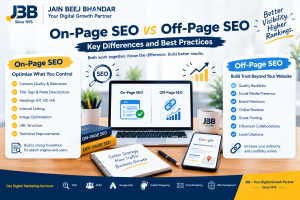
On-Page SEO vs Off-Page SEO: Key Differences and Best Practices
Meta Title: On-Page SEO vs Off-Page SEO: Key Differences & Tips
Meta Description: Learn the difference between on-page SEO and off-page SEO, explore ranking factors, keyword optimisation, backlinks, and proven SEO best practices.
Focus Keyword: On-Page SEO vs Off-Page SEO
Secondary Keywords: on-page SEO, off-page SEO, on-page SEO techniques, off-page SEO techniques, on-page SEO factors, off-page SEO factors, SEO optimisation, search engine optimisation, link building, quality backlinks, internal linking, technical SEO, website authority, organic search rankings, SEO strategy for small businesses.
Featured Image Alt Text: On-Page SEO vs Off-Page SEO comparison showing website optimisation, quality backlinks, internal linking, and search engine optimisation strategies.
Introduction: Understanding On-Page SEO and Off-Page SEO
Want your website to appear more prominently in Google search results and attract more relevant visitors? To build an effective search engine optimisation strategy, you need to understand two important areas: on-page SEO and off-page SEO.
Both contribute to your website’s overall search visibility, but they focus on different activities.
On-page SEO involves improving the content and elements of your website so that search engines and visitors can understand your pages more easily. It includes content quality, title tags, headings, internal links, image optimisation, and other page-level improvements.
Off-page SEO focuses on activities outside your website that can support its reputation, authority, and visibility. These may include earning quality backlinks, building brand awareness, gaining genuine mentions, and developing relationships with relevant websites.
For example, imagine you own a digital marketing agency. You optimise your SEO service page with helpful content, descriptive headings, relevant keywords, and clear navigation. These are on-page SEO activities. If an industry website later references your useful guide and links to your page, that may contribute to your off-page SEO efforts.
Understanding on-page SEO vs off-page SEO helps you develop a balanced strategy rather than relying on just one technique.
At JBB – Your Digital Growth Partner, Since 1975, we believe sustainable digital growth starts with a useful website, relevant content, and a strong online presence. In this guide, you will learn the differences between on-page and off-page SEO, their benefits, important ranking considerations, common mistakes, and how to use both in a practical SEO strategy.
What Is On-Page SEO?
On-page SEO is the process of optimising individual website pages and their content to help search engines understand their purpose and help visitors find the information they need.
It focuses on elements you can generally manage directly on your own website.
The main objective is to create pages that are relevant, helpful, accessible, easy to navigate, and aligned with the searcher’s intent.
Important On-Page SEO Factors
1. High-quality website content
Content should answer users’ questions accurately and provide meaningful value. A page should explain the topic clearly instead of repeating keywords just to influence rankings.
2. Keyword optimisation
Use relevant SEO keywords naturally in the page title, main heading, introduction, and other appropriate sections. Include related phrases where they help explain the topic.
3. Title tags
A descriptive SEO title helps communicate the page’s subject to search engines and potential visitors. Make it specific, useful, and relevant to the page.
4. Meta descriptions
A well-written meta description summarises the page and may encourage relevant searchers to click. Google can generate a different search snippet based on the query, so the supplied description is not guaranteed to appear exactly as written.
5. Heading structure
Use a clear main heading and meaningful subheadings to organise the information. A logical structure makes content easier to scan and understand.
6. Internal linking
Link to related pages on your website when doing so helps users discover useful information. Internal links can also help search engines find and understand your pages.
7. Image optimisation
Use relevant images with descriptive filenames and appropriate alternative text. Compress images where appropriate to help manage page loading performance.
8. URL structure
Use clear, descriptive URLs that make the subject of a page easy to understand. Avoid unnecessarily complicated or repetitive URL structures.
9. Mobile usability and page experience
Ensure your website works well on mobile devices, text is readable, navigation is usable, and important content is easy to access.
10. Search intent alignment
Make sure the page actually answers the question or meets the need behind the target search query.
Learn more from Google’s official SEO Starter Guide.
What Is Off-Page SEO?
Off-page SEO refers to activities outside your website that can help build your online reputation, discoverability, and authority.
Unlike on-page SEO, you cannot directly control every external reference or link. Instead, the focus is on creating value that other people and websites may genuinely want to mention, reference, or share.
Important Off-Page SEO Factors
1. Quality backlinks
A backlink is a link from another website to yours. Links earned from relevant, trustworthy websites can help people discover your content and may contribute to Google’s understanding of your pages and reputation.
2. Digital PR
Digital public relations involves sharing newsworthy information, useful research, expert insights, or original resources that may attract legitimate media coverage and relevant links.
3. Brand mentions
When people discuss your business online, those mentions can help build awareness and recognition. Not every brand mention contains a link, and an unlinked mention should not be assumed to have the same SEO effect as a backlink.
4. Content promotion
Promoting genuinely useful articles through relevant channels can help them reach readers who may find the information valuable and reference it later.
5. Genuine business relationships
Partnerships with relevant organisations, industry groups, suppliers, and professional communities may create opportunities for legitimate exposure and referrals.
6. Local business citations
For businesses serving a specific area, accurate listings in relevant directories can help people discover the business and verify its information. Focus on trustworthy, appropriate directories rather than submitting your details to every available website.
7. Customer reviews and reputation
Honest customer feedback can influence how potential customers perceive your business. Review management is particularly useful for local businesses, although reviews should not be treated as a guaranteed ranking shortcut.
8. Social media distribution
Sharing content on social platforms can help it reach a wider audience. Social media engagement should not be treated as a direct, guaranteed Google ranking factor, but it can support awareness and content discovery.
For Google’s guidance on links, visit its documentation about qualifying outbound links.
On-Page SEO vs Off-Page SEO: Key Differences
Although both contribute to a wider SEO strategy, on-page and off-page SEO differ in their focus and implementation.
| Comparison | On-Page SEO | Off-Page SEO |
|---|---|---|
| Main focus | Website content and page elements | External reputation and visibility |
| Location | Within your website | Primarily outside your website |
| Control | Generally more directly controllable | Often depends on third parties |
| Examples | Content, headings, title tags, internal links | Earned backlinks, digital PR, brand mentions |
| Main purpose | Help pages satisfy search intent and communicate relevance | Build awareness, credibility, and authority |
| Keyword role | Helps communicate page topic naturally | Supports discoverability of useful content |
| Measurement | Content quality, indexing, clicks, impressions, conversions | Relevant referring domains, earned links, referrals, brand exposure |
| Typical challenge | Creating useful, well-structured content | Earning legitimate attention and references |
| Common risk | Keyword stuffing and thin content | Manipulative link schemes and paid-link abuse |
The key difference: On-page SEO improves the page itself, while off-page SEO focuses on signals and exposure beyond your website. Both should support the same business and audience goals.
Why Is On-Page SEO Important?
On-page SEO helps create a strong foundation for your website. Even if your business receives links or mentions from other websites, visitors still need useful content and a good experience when they arrive.
1. Helps Search Engines Understand Your Pages
Clear titles, descriptive headings, relevant content, and sensible internal links provide context about the subjects covered by your pages.
2. Improves Content Relevance
On-page SEO optimisation helps you align each page with the audience’s questions and needs. This makes your website more useful to people searching for relevant information.
3. Supports Better User Experience
Readable content, logical navigation, mobile usability, and relevant images make it easier for visitors to find answers and explore your services.
4. Helps Search Engines Discover Related Pages
Relevant internal links connect your content and provide paths for users and search engines to discover other pages.
For example, a blog post about keyword research could link to your SEO service page when the link offers readers a useful next step.
5. Supports Conversions
A well-organised page can help visitors understand your services, evaluate your approach, and find a clear way to contact your business.
Explore JBB’s SEO services to see how website optimisation fits into a wider digital marketing strategy.
Why Is Off-Page SEO Important?
Off-page SEO helps your business build visibility beyond its own website.
1. Can Help Build Website Authority
Relevant, editorially earned backlinks can help people discover your website and may contribute to how search engines evaluate your content.
Focus on earning links because your content is useful—not on collecting the largest possible number of backlinks.
2. Expands Brand Awareness
When your business is mentioned in relevant publications, professional communities, or industry resources, new audiences may learn about your services.
3. Creates Referral Traffic Opportunities
A link from a relevant website may send visitors directly to your content. These visitors can be valuable even when they do not immediately convert.
4. Supports Long-Term Reputation
Useful resources, professional relationships, genuine customer feedback, and trustworthy external references can contribute to your brand’s reputation over time.
5. Complements Your On-Page SEO
A helpful, well-optimised page gives other websites something worthwhile to reference. Off-page efforts can then help more people discover that content.
Important: Off-page SEO is not simply buying links or submitting your website to hundreds of directories. Focus on relevance, trust, genuine relationships, and useful content.
Best On-Page SEO Techniques for Better Website Performance
Use these practical on-page SEO best practices when creating or updating your website pages.
1. Research Relevant Keywords
Identify the phrases your target audience uses and understand the purpose behind those searches.
Use one clear primary topic for each page, along with relevant supporting terms. Avoid assigning multiple pages the same purpose when one useful page could satisfy the search intent.
2. Write Descriptive SEO Titles
Your page title should accurately describe the content and communicate its value.
For example:
- Weak: “SEO Tips”
- Better: “On-Page SEO Checklist: 10 Ways to Improve Your Website”
Keep titles natural and specific rather than adding multiple repetitive keywords.
3. Create Helpful, Original Content
Answer the reader’s main question early and provide supporting detail, examples, and useful next steps.
Avoid padding articles with repeated explanations just to increase word count. Longer content is not automatically better if it does not improve the answer.
4. Optimise Headings Naturally
Use descriptive headings that explain what each section covers. Include target keywords where they make sense, but do not force exact-match phrases into every heading.
5. Improve Internal Linking
Connect related pages using clear anchor text.
For example, an article about social media strategy could link to JBB’s Social Media Marketing service where relevant.
Internal links should help readers navigate your website rather than exist only to repeat keywords.
6. Optimise Images
Use suitable image dimensions, compress files where possible, and provide descriptive alternative text for meaningful images.
Alternative text should describe the image’s purpose or content. It should not become a list of unrelated keywords.
7. Review Technical Issues
Make sure important pages can be accessed and indexed appropriately. Check for broken links, unintended indexing restrictions, mobile usability problems, and slow-loading resources.
Learn more about technical foundations in Google’s technical requirements for Search.
Best Off-Page SEO Techniques for Building Online Authority
The following off-page SEO strategies can help your business build genuine visibility and relationships.
1. Create Resources Worth Referencing
Publish useful guides, original research, practical checklists, expert explanations, or industry resources that other websites may want to reference.
A useful resource gives publishers a reason to link to your website because it helps their own readers.
2. Earn Relevant Backlinks
Reach out to relevant publishers or organisations when you have a genuinely useful resource for their audience.
Avoid mass email campaigns that offer no clear value, and never misrepresent your business or content.
3. Use Digital PR
Share legitimate business news, original findings, expert commentary, or relevant community initiatives with suitable publications.
Digital PR should focus on stories and resources that are interesting to the intended audience, not merely on obtaining links.
4. Build Relevant Industry Relationships
Collaborate with reputable businesses, professional associations, suppliers, or community organisations where the relationship is genuine.
These relationships may lead to referrals, useful exposure, and relevant editorial references.
5. Improve Your Local Online Presence
For eligible local businesses, maintain accurate details across relevant directories and business platforms.
Keep your business name, address, and phone number consistent where applicable, and avoid creating duplicate or misleading listings.
6. Promote Useful Content
Share articles and resources with people who may genuinely benefit from them. Social media, email newsletters, and professional communities can help your content reach the right audience.
7. Follow Google’s Link Policies
Avoid buying links intended to manipulate rankings, participating in link exchanges at scale, or using automated link-building schemes.
Review Google’s official spam policies for Google web search before implementing link-building tactics.
How On-Page SEO and Off-Page SEO Work Together
The strongest strategy does not treat these activities as separate campaigns. Instead, on-page SEO and off-page SEO work together to support a website’s visibility and usefulness.
Consider a digital marketing agency publishing an in-depth guide to local SEO.
Step 1: Research the topic. Identify the questions local business owners ask and select a suitable primary keyword.
Step 2: Optimise the page. Create helpful content, a descriptive title, clear headings, relevant internal links, and an appropriate page structure.
Step 3: Publish supporting resources. Add related content about Google Business Profile optimisation, local keyword research, and website improvements where those topics serve distinct needs.
Step 4: Promote the resource. Share it with relevant audiences and professional communities that may find it useful.
Step 5: Earn genuine references. If other publishers find the guide valuable, they may reference it in their own content.
Step 6: Measure the results. Monitor impressions, clicks, relevant referral traffic, engagement, and enquiries where measurement is available.
This approach builds from a useful page outward. It avoids trying to promote content that does not adequately answer the reader’s question.
On-Page SEO vs Off-Page SEO: Which Should You Focus on First?
For most websites, it makes sense to establish a solid on-page foundation before investing heavily in off-page promotion.
| Website situation | Recommended starting point |
|---|---|
| New website with very little content | Build useful core pages and a clear site structure |
| Pages target the wrong search intent | Improve content relevance and page purpose |
| Important pages are not indexed | Investigate indexing and technical accessibility |
| Useful content receives little exposure | Promote it to relevant audiences and seek legitimate references |
| Website has poor-quality backlinks from past campaigns | Review link risks and follow Google’s guidance |
| Local business profile is incomplete | Correct profile details and improve the wider local presence |
| Website gets visitors but few enquiries | Review page usefulness, trust signals, and conversion paths |
There is no universal rule that on-page SEO must always come first. If your website already has useful, technically accessible content, relevant off-page activities may be appropriate at the same time.
The right priority depends on your website’s current condition, audience, competition, and objectives.
Common SEO Mistakes to Avoid
1. Keyword Stuffing
Repeating the same phrase excessively can make content unnatural and unhelpful. Use relevant keywords where they fit the subject and sentence.
2. Publishing Thin Content
Pages that provide little value may fail to meet the user’s needs. Create content that answers the question with appropriate detail and practical examples.
3. Buying Manipulative Backlinks
Buying links intended to influence search rankings can violate Google’s spam policies. Focus on earning relevant links through useful content and legitimate relationships.
4. Ignoring Internal Links
Without relevant internal links, visitors may struggle to discover supporting information. Connect related pages wherever doing so improves navigation.
5. Creating Duplicate or Overlapping Pages
Publishing many pages that target essentially the same query can create unnecessary duplication. Give each page a clear purpose and consolidate content where appropriate.
6. Neglecting Mobile Usability
A website should be readable and usable on mobile devices as well as desktops. Check navigation, text size, forms, and page loading performance.
7. Measuring Only Keyword Rankings
Rankings can provide useful context, but they do not tell the whole story. Review organic clicks, relevant traffic, enquiries, and conversions where data is available.
8. Expecting Instant Results
SEO improvements can take time, and outcomes depend on competition and other factors. Avoid agencies or strategies that promise guaranteed positions or overnight success.
On-Page and Off-Page SEO Checklist
Before reviewing your SEO strategy, use this checklist.
On-page SEO checklist
-
Each important page has a clear purpose.
-
Content answers the user’s search intent.
-
Titles and headings describe the content accurately.
-
Relevant keywords are used naturally.
-
Internal links connect related pages.
-
Images have suitable sizes and descriptive alt text where needed.
-
Important pages are accessible and indexable.
-
The website is usable on mobile devices.
-
Pages provide clear next steps for interested visitors.
Off-page SEO checklist
-
Publish resources worth referencing.
-
Promote useful content to relevant audiences.
-
Seek legitimate editorial and industry relationships.
-
Review referring domains and link quality.
-
Maintain accurate relevant business listings.
-
Encourage honest customer feedback where applicable.
-
Avoid paid or automated link schemes intended to manipulate rankings.
-
Measure relevant referral traffic and business outcomes.
How JBB Can Help With Your SEO Strategy
At JBB – Your Digital Growth Partner, Since 1975, we understand that effective digital marketing requires a combination of useful content, a well-structured website, relevant promotion, and consistent optimisation.
Our services support different parts of your online growth strategy:
- SEO: Improve website content, page structure, and search optimisation.
- Social Media Marketing: Share relevant content and build relationships with your audience.
- Google Ads: Reach potential customers through targeted paid search campaigns.
- Graphic Designing: Create professional visual content that communicates your brand clearly.
- Email Marketing: Maintain useful communication with interested customers.
- Web Development: Build responsive websites designed to support usability and business goals.
Explore the relevant JBB services:
A suitable combination depends on your business goals, available resources, website condition, and target audience. SEO should be planned around measurable business needs rather than isolated ranking metrics.
Frequently Asked Questions
1. What is the main difference between on-page SEO and off-page SEO?
On-page SEO focuses on optimising your website’s content and page elements. Off-page SEO focuses on activities beyond your website that can support its reputation, authority, and visibility, such as earning relevant backlinks and building genuine industry relationships.
2. Which is more important: on-page SEO or off-page SEO?
Neither is universally more important. On-page SEO helps make your pages useful and relevant, while off-page SEO can help people discover your content and build your broader online presence. The right balance depends on your website’s current needs.
3. What are examples of on-page SEO?
Examples include writing useful content, improving title tags, structuring headings, optimising images, creating relevant internal links, using descriptive URLs, and ensuring that pages satisfy search intent.
4. What are examples of off-page SEO?
Examples include earning relevant editorial backlinks, digital PR, building genuine industry relationships, promoting useful resources, and maintaining an accurate local business presence where applicable.
5. Do backlinks still matter for SEO?
Relevant backlinks can help users discover your content and may contribute to how search engines assess your pages. However, the number of links alone does not guarantee better rankings. Focus on quality, relevance, and legitimate link acquisition.
6. Can I rank a website using only on-page SEO?
A website may gain search visibility through strong, relevant content and good technical foundations, but results depend on the topic and competition. Off-page exposure may be useful for some websites, while others may already have sufficient external recognition.
7. Is social media part of off-page SEO?
Social media can support content distribution, brand awareness, and audience engagement. However, social shares should not be treated as a direct or guaranteed Google ranking factor. Its value often comes from helping the right people discover your content.
8. How long does SEO take to show results?
There is no guaranteed timeline. Results depend on factors such as competition, website history, technical issues, content quality, and the changes being made. Monitor performance over time rather than expecting immediate rankings.
9. How can small businesses improve both on-page and off-page SEO?
Start with helpful website pages, accurate business information, clear navigation, and relevant internal links. Then promote useful content, build legitimate industry relationships, maintain a trustworthy local presence, and earn genuine references where possible.
10. Can an SEO agency guarantee first-page Google rankings?
No responsible agency can guarantee a specific Google ranking. Search results can change based on competition, search context, and other factors. Choose an SEO provider that explains its methods clearly, follows search policies, and reports meaningful performance data.
Conclusion: Build a Balanced SEO Strategy for Long-Term Growth
Understanding on-page SEO vs off-page SEO helps you build a more complete search engine optimisation strategy.
On-page SEO focuses on making your website clear, relevant, accessible, and useful. Off-page SEO helps expand your visibility and reputation through genuine references, relationships, and content discovery.
Start by improving your most important website pages, creating useful content, strengthening internal links, and checking technical accessibility. Then focus on promoting resources that deserve attention and building a trustworthy online presence.
Remember, successful SEO is not about manipulating search engines or collecting as many keywords and backlinks as possible. It is about helping people find reliable answers and useful services.
Ready to strengthen your online presence? Explore JBB’s SEO services and discover how a structured digital marketing strategy can support your business goals.
JBB – Your Digital Growth Partner | Since 1975