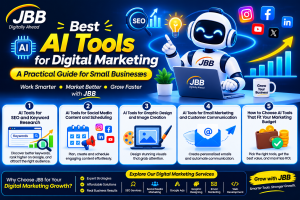
Best AI Tools for Digital Marketing: A Practical Guide for Small Businesses
Focus Keyword: AI tools for digital marketing
SEO Title: Best AI Tools for Digital Marketing for Small Businesses | JBB
Meta Description: Discover the best AI tools for digital marketing, including SEO, social media, graphic design, and email marketing tools to grow your business with JBB.
Introduction: Grow Your Business Smarter with AI
Running a small business in today’s competitive digital world is not easy. Business owners need to attract customers, create engaging content, improve website visibility, manage advertising campaigns, and communicate with potential buyers. Doing everything manually can consume valuable time and resources.
This is where AI tools for digital marketing can make a real difference. Artificial intelligence helps businesses research keywords, generate content ideas, design marketing creatives, automate repetitive tasks, and analyze campaign performance more efficiently.
However, using AI tools alone does not guarantee business growth. You need the right tools, a clear strategy, and a proper understanding of your target audience.
At JBB, we believe that smart technology combined with effective digital marketing strategies can help businesses strengthen their online presence and reach potential customers more efficiently. Our digital marketing solutions help businesses explore opportunities across search engines, social media, paid advertising, graphic design, email marketing, and website development.
Whether you are a startup, a local business owner, or an established company, this practical guide will help you understand the best AI tools for digital marketing and how to choose the right ones for your business.
1. AI Tools for SEO and Keyword Research
Search engine optimization (SEO) helps businesses improve their visibility on search engines such as Google. However, finding relevant keywords, understanding search intent, analyzing competitors, and optimizing website content require careful research.
AI tools for digital marketing can simplify many SEO tasks by helping marketers organize information, discover content opportunities, and develop more effective optimization strategies.
Best AI and AI-assisted tools for SEO
1. ChatGPT
ChatGPT can help you brainstorm keyword variations, organize content topics, develop article outlines, and create initial drafts of SEO titles and meta descriptions.
For example, if you operate a shoe-cleaning business in Indore, you could explore search phrases such as “best shoe laundry in Indore,” “professional shoe cleaning services,” and “sneaker cleaning near me.”
These suggestions should be validated using keyword research tools before you target them.
2. Semrush
Semrush provides keyword research, competitor analysis, rank tracking, and other SEO features. Its AI-assisted capabilities can support content planning and optimization, depending on your selected plan.
3. Ahrefs
Ahrefs helps marketers research keywords, examine backlinks, analyze competing websites, and identify content opportunities.
4. Google Search Console
Google Search Console is a valuable tool for understanding how your website performs in Google Search. It provides information about search queries, impressions, clicks, and indexing issues. It is not primarily an AI writing tool, but it provides real performance data that can guide your SEO strategy.
How AI improves SEO
- Helps generate keyword ideas and related search terms.
- Supports the creation of structured blog outlines.
- Assists with title and meta description variations.
- Helps organize topic clusters and content plans.
- Supports competitor research when used with appropriate SEO data.
- Helps identify opportunities for updating existing content.
For professional support, explore JBB’s SEO Services to learn how a well-planned SEO strategy can help your business work toward better organic visibility.
Pro tip: Do not publish AI-generated articles without checking facts, search intent, originality, and usefulness. Content should answer real customer questions rather than simply repeat keywords.
2. AI Tools for Social Media Content and Scheduling
Social media platforms provide businesses with opportunities to connect with customers, showcase products, share expertise, and generate enquiries.
The challenge is maintaining a consistent publishing schedule while producing fresh and engaging content.
Using AI tools for digital marketing can help small businesses plan campaigns, draft captions, brainstorm creative ideas, and streamline their publishing workflow.
Best AI tools for social media marketing
1. ChatGPT
Use ChatGPT to brainstorm post ideas, write caption drafts, develop short-video scripts, create content calendars, and adapt messages for different platforms.
For example, a clothing store could develop a week’s worth of educational, promotional, and engagement-focused post ideas around a new collection.
2. Canva
Canva offers design tools and AI-assisted features that can help users create social media posts, presentations, promotional graphics, and other marketing assets.
3. Buffer
Buffer helps businesses plan and schedule social media content across supported platforms. Its available AI features can assist with generating or refining post ideas and captions.
4. Meta Business Suite
Meta Business Suite supports managing Facebook and Instagram business activity, including content publishing, scheduling, messaging, and performance insights. Available features depend on account setup and platform updates.
Benefits of AI-powered social media marketing
- Save time when developing content ideas.
- Maintain a more consistent publishing schedule.
- Create different caption variations for testing.
- Adapt content to different platforms.
- Review engagement data and identify useful patterns.
- Organize campaigns around launches, offers, and seasonal events.
For example, a local restaurant could use AI to brainstorm menu-highlight posts, prepare promotional caption drafts, and schedule content around upcoming events. The restaurant team can then add real photographs, accurate prices, and authentic customer experiences.
At JBB, our Social Media Marketing Services focus on helping businesses develop a more structured online presence and connect their content strategy with their marketing goals.
Remember: Posting frequently is not the same as achieving results. Focus on useful content, genuine interactions, and measurable engagement rather than chasing likes alone.
3. AI Tools for Graphic Design and Image Creation
Visual content often creates the first impression of a brand. Attractive graphics, product images, banners, and advertisements can help businesses communicate their message clearly.
However, hiring designers for every small creative requirement may not be practical for businesses with limited budgets.
AI-powered design tools can help users explore ideas, create initial layouts, and produce marketing visuals more efficiently.
Best AI tools for graphic design
1. Canva AI
Canva provides AI-assisted design capabilities that help users develop layouts, generate design ideas, and adapt visuals for different formats.
2. Adobe Firefly
Adobe Firefly offers generative AI capabilities for creating and editing visual assets. Businesses should review the applicable usage terms and licensing requirements before using generated assets commercially.
3. ChatGPT image generation
ChatGPT can help generate original visual concepts and images based on detailed prompts, depending on the features available in your plan.
4. Adobe Express
Adobe Express provides design tools and AI-assisted features for creating promotional graphics, social media content, and other branded materials.
What can businesses create with AI design tools?
- Social media posts and carousel graphics.
- Website banners and promotional visuals.
- Product campaign concepts.
- Event announcements and digital invitations.
- Advertising creative variations.
- Blog featured images and infographics.
Imagine a small bakery preparing for Diwali. AI-assisted design tools can help the team explore festive visual concepts, develop promotional layouts, and create draft social media graphics without beginning every design from scratch.
The final creative should still reflect the bakery’s actual products, brand identity, prices, and offer conditions.
Businesses looking for professional creative support can explore JBB’s Graphic Designing Services to learn more about visual communication for digital marketing.
Pro tip: Use consistent brand colors, fonts, logos, and visual styles. A beautiful design is more effective when customers can recognize your business.
4. AI Tools for Email Marketing and Customer Communication
Email marketing remains a useful channel for sharing updates, promoting offers, nurturing leads, and maintaining relationships with existing customers.
AI-assisted email tools can help marketers write subject lines, personalize content, organize audience segments, and improve campaign workflows.
Best AI tools for email marketing
1. Mailchimp
Mailchimp provides email campaign management, audience tools, automation, and AI-assisted marketing features in supported plans.
2. Brevo
Brevo offers email marketing, marketing automation, and customer communication features. Available AI capabilities and limits depend on the plan.
3. HubSpot
HubSpot provides marketing, CRM, and customer management tools, with AI-assisted features available across selected products and plans.
4. ChatGPT
ChatGPT can help draft email subject lines, promotional messages, welcome emails, follow-up sequences, and newsletters. It can also suggest alternative wording for different audience segments.
How AI can improve email marketing
- Generate subject-line variations.
- Create initial drafts for newsletters.
- Personalize messages using appropriate customer information.
- Organize content for different audience segments.
- Assist with automated email sequence planning.
- Analyze campaign results when provided with relevant data.
For example, an online clothing store could send a welcome email to new subscribers, a product-update email to interested customers, and a follow-up email to customers who have agreed to receive marketing communications.
Personalization should always use accurate information and respect customer privacy and consent requirements.
To learn more about professional email campaigns, visit JBB’s Email Marketing Services.
AI and customer communication
AI-assisted chatbots can also answer common questions, direct customers to relevant information, and help businesses manage routine enquiries.
For instance, a website chatbot could guide a visitor toward the right service page, explain basic service information, or help the visitor contact the appropriate team.
Explore JBB’s Web Development Services to understand how a well-designed website can support your digital marketing and customer communication efforts.
Always provide a way for customers to reach a human representative when their enquiry requires personal attention.
5. How to Choose AI Tools That Fit Your Marketing Budget
With so many AI platforms available, choosing the right tools can feel confusing. Some offer free plans, while others charge monthly subscriptions or additional fees for advanced features.
The best choice is not necessarily the most expensive tool. It is the tool that solves a genuine business problem and provides value relative to its cost.
Step 1: Identify your biggest marketing challenge
Start by deciding what you need help with.
- Need more website visibility? Explore SEO and keyword research tools.
- Struggling to publish social media content? Consider content planning and scheduling tools.
- Need attractive promotional graphics? Explore AI-assisted design tools.
- Want to improve email campaigns? Consider email marketing and automation platforms.
- Need a better online customer experience? Evaluate website and communication solutions.
Step 2: Start with free plans where possible
Many tools provide free plans, trials, or limited free features. Test the tools that match your requirements before committing to a paid subscription.
Check usage limits, export options, commercial-use permissions, integrations, and feature restrictions before making a decision.
Step 3: Calculate the actual cost
Consider more than the monthly subscription price.
Your total cost may include:
- Monthly or annual subscription charges.
- Extra credits for AI image or video generation.
- Additional user accounts.
- Integration or automation expenses.
- Staff training and implementation time.
Step 4: Measure the value
Track whether the tool saves time, improves content quality, increases qualified enquiries, or helps your team make better marketing decisions.
For example, if an AI tool saves your team five hours each month, compare the value of that saved time with the total cost of the subscription.
Step 5: Avoid unnecessary subscriptions
You do not need ten AI tools to run effective digital marketing. Begin with a small number of tools that solve your most important problems, then expand when you have evidence that additional features are worthwhile.
A practical AI tool selection guide
| Business requirement | Tools to explore | Main purpose |
|---|---|---|
| SEO and keyword research | Semrush, Ahrefs, ChatGPT | Keyword ideas and SEO planning |
| Social media content | ChatGPT, Buffer, Meta Business Suite | Content planning and publishing |
| Graphic design | Canva, Adobe Firefly, Adobe Express | Marketing visuals and design |
| Email marketing | Brevo, Mailchimp, HubSpot | Email campaigns and automation |
| Website performance | Google Search Console, Google Analytics | Search and traffic analysis |
Tool features, free-plan limits, and pricing can change. Check the providers’ official websites before selecting a tool.
Businesses can also explore JBB’s Google Ads Services when paid search advertising is relevant to their goals. AI-assisted advertising features can support campaign optimization, but results still depend on targeting, landing pages, budget, and campaign management.
6. How Small Businesses Can Build an AI-Powered Digital Marketing Strategy
Selecting tools is only the beginning. To get value from AI tools for digital marketing, businesses should connect them to a clear plan.
Here is a practical workflow to follow.
Step 1: Set a measurable goal
Choose a specific objective, such as increasing qualified enquiries, improving organic traffic, or reducing the time needed to prepare marketing content.
Step 2: Research your audience
Understand your ideal customers, their needs, their questions, and the platforms they use.
Step 3: Select suitable tools
Choose tools that address your priorities without creating unnecessary complexity or expense.
Step 4: Create and review marketing content
Use AI to prepare drafts and ideas, then verify the information, refine the messaging, and ensure that the content matches your brand.
Step 5: Publish and promote
Share content on appropriate platforms. Use organic marketing and paid advertising according to your objectives and budget.
Step 6: Measure performance
Track relevant metrics such as search impressions, website visits, engagement, email clicks, qualified leads, and conversions.
Step 7: Improve your strategy
Review the results regularly, identify what works, and adjust your campaigns based on evidence.
A coordinated strategy across SEO, social media, paid advertising, email, design, and website development can help businesses create a more consistent digital presence.
At JBB, businesses can explore digital marketing services that support different stages of their online growth journey.
7. Common Mistakes to Avoid When Using AI Marketing Tools
AI can improve productivity, but using it without a strategy can create new problems.
Publishing unchecked content: AI-generated content may contain errors, unsupported claims, or repetitive language. Review everything before publishing.
Targeting irrelevant keywords: High search volume does not automatically mean a keyword will attract the right customers.
Using generic visuals: Marketing creatives should reflect your actual products, services, and brand identity.
Ignoring customer privacy: Use customer information responsibly and follow applicable privacy, consent, and data protection requirements.
Automating every interaction: Human support remains important for complicated enquiries, complaints, and relationship-building.
Expecting immediate results: AI cannot guarantee rankings, leads, sales, or social media growth.
Paying for tools you rarely use: Review your subscriptions and keep only those that provide practical value.
The goal is to use AI responsibly to improve marketing quality, efficiency, and decision-making.
8. Why Choose JBB for Digital Marketing Services?
Choosing the right digital marketing partner can help you turn scattered marketing activities into a more organized business strategy.
At JBB, businesses can explore digital marketing services across several important areas:
- SEO Services: Support your website’s organic search visibility and content strategy.
- Social Media Marketing: Develop a consistent presence and connect with relevant audiences.
- Google Ads: Reach potential customers through paid advertising campaigns.
- Graphic Designing: Create visual assets for your brand and marketing campaigns.
- Email Marketing: Support customer communication and lead nurturing.
- Web Development: Build a website that supports your services, brand, and customer journey.
For small businesses, the benefit of a coordinated approach is that each marketing activity can support the others. Social media can introduce your brand, SEO can help customers discover your website, email marketing can nurture interested prospects, and paid advertising can support targeted campaigns.
The right combination depends on your business model, audience, resources, and objectives.
Visit JBB to explore the available services and identify which digital marketing solutions may fit your needs.
Frequently Asked Questions (FAQs)
1. What are AI tools for digital marketing?
AI tools for digital marketing are applications that use artificial intelligence to assist with tasks such as keyword research, content creation, graphic design, email marketing, audience analysis, and campaign optimization.
2. Which AI tools are best for small businesses?
The best tools depend on your requirements. ChatGPT can assist with content ideas, Canva can support design, Semrush and Ahrefs can assist with SEO research, and Brevo or Mailchimp can support email marketing. Start with tools that solve your most important challenges.
3. Are AI marketing tools free?
Some tools offer free plans or limited free features, while others require paid subscriptions. Features, usage limits, and pricing vary, so compare current plans before making a purchase.
4. Can AI tools replace a digital marketing agency?
AI tools can assist with many marketing tasks, but they do not automatically replace strategy, campaign management, creative judgment, technical expertise, or human customer understanding. Businesses may benefit from combining appropriate tools with professional support.
5. How can AI tools improve SEO?
AI can help with keyword brainstorming, content outlines, topic planning, and draft optimization. However, effective SEO also requires search intent analysis, technical checks, useful content, quality control, and ongoing performance measurement.
6. Are AI-generated blog articles good for SEO?
AI-assisted articles can be useful when they provide accurate, original, relevant, and genuinely helpful information. Simply generating large quantities of content without quality control does not guarantee good rankings.
7. How can JBB help my business grow online?
You can explore JBB’s digital marketing services to learn about available solutions for SEO, social media marketing, Google Ads, graphic design, email marketing, and web development. The right approach depends on your business objectives and marketing requirements.
Conclusion: Choose the Right AI Tools and Grow Smarter with JBB
The future of digital marketing is not about using the largest number of AI tools. It is about choosing the right tools, using them effectively, and connecting them to a clear business strategy.
AI tools for digital marketing can help small businesses save time, develop content ideas, improve marketing workflows, understand performance data, and communicate with customers more efficiently.
However, sustainable growth still requires useful content, a strong brand identity, accurate information, customer trust, and consistent improvement.
By combining AI-assisted tools with human creativity and an effective marketing strategy, businesses can make better use of their time and resources.
Ready to strengthen your online presence? Visit JBB and explore our SEO Services, Social Media Marketing, Google Ads, Graphic Designing, Email Marketing, and Web Development to discover the options that best fit your business.
JBB — Work Smarter. Market Better. Grow Stronger.