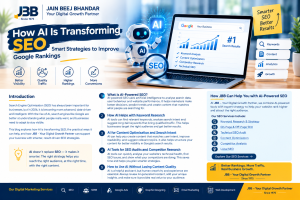
How AI Is Transforming SEO: Smart Strategies to Improve Google Rankings
In today’s competitive online world, getting your website noticed on Google requires more than simply publishing content and adding keywords. Businesses need to understand their audience, create useful information, improve website performance, and adapt to changing search behaviour. This is where AI in SEO is becoming an important part of modern digital marketing.
Artificial Intelligence is helping marketers research keywords, understand search intent, identify website issues, analyse competitors, and plan better content. When used correctly, these capabilities can make search engine optimisation more organised, efficient, and data-informed.
However, AI does not guarantee higher Google rankings. Successful SEO still depends on helpful content, technical website quality, relevant information, user experience, and consistent improvement.
At JBB – Your Digital Growth Partner, we believe that combining modern technology with a clear SEO strategy can help businesses strengthen their online presence and reach more relevant customers.
In this guide, we will explore how AI-powered SEO works, how it supports marketing activities, and how businesses can use AI without sacrificing content quality.
1. What Is AI-Powered SEO?
AI-powered SEO means using artificial intelligence tools to support activities that help improve a website’s visibility in organic search results.
Traditional SEO involves understanding search terms, creating relevant content, improving website structure, fixing technical issues, and earning relevant links. AI can assist with many of these tasks by processing information, identifying patterns, and generating recommendations.
For example, AI in SEO can help marketers:
- Discover relevant SEO keywords and related search queries.
- Understand what users want when they search for a topic.
- Organise blog content into useful headings and sections.
- Identify potential technical SEO problems.
- Compare website content with competing pages.
- Review available performance data and suggest areas for improvement.
Imagine you run a local business and want your website to appear when potential customers search for your services. AI tools can help you explore the questions customers ask, plan relevant website content, and identify pages that may need improvement.
The important point is that AI supports the process rather than replacing SEO expertise. Recommendations must be reviewed, checked, and implemented according to your website’s actual needs.
For businesses looking to improve their search visibility, explore JBB SEO Services.
2. How AI Helps with Keyword Research
Keyword research with AI can help marketers understand the words and questions people use when looking for products, services, or information online.
Instead of focusing on only one broad keyword, businesses can explore related search phrases, specific customer questions, and different stages of the buying journey.
Find Relevant Keywords
AI tools can generate keyword ideas based on your business, services, audience, and location. These ideas can help you identify topics worth investigating further.
For example, a digital marketing agency could explore terms such as:
- AI in SEO
- AI SEO tools
- How to improve Google rankings
- SEO services for small businesses
- AI-powered keyword research
- Search engine optimisation strategies
These are examples of potential keyword targets, not verified search-volume figures. Validate them using tools such as Google Keyword Planner, Google Trends, and Google Search Console where suitable data is available.
Discover Long-Tail Keywords
Long-tail keywords are more specific search phrases that often reveal a clearer customer need.
For example, instead of targeting only “SEO,” a business might research phrases such as “SEO services for small businesses in India.”
Specific keywords can help you create content that addresses a particular audience or problem. Their actual value depends on search demand, competition, and relevance to your services.
Understand Search Intent
Search intent refers to what a person hopes to achieve through a search.
Common intent types include:
- Informational intent: The person wants to learn something.
- Navigational intent: The person wants to find a particular website or brand.
- Commercial investigation: The person is comparing possible solutions.
- Transactional intent: The person is ready to take an action, such as purchasing or requesting a service.
AI can help group keyword ideas by likely intent, but you should review the actual search results and customer needs before deciding what content to create.
How JBB Can Help
Effective keyword research connects customer needs with the right pages and content. A well-planned SEO strategy should prioritise relevant search opportunities rather than simply repeating popular keywords.
Explore JBB SEO Services to learn more about building a search strategy around your business goals.
3. AI for Content Optimisation and Search Intent
Creating content is only one part of SEO. Your content also needs to answer the reader’s question clearly, provide useful information, and make the next step easy to understand.
AI content optimisation can help improve the organisation, readability, and relevance of website pages and blog articles.
Create Better Content Outlines
AI can help suggest headings, subheadings, related questions, and content structures based on a topic.
For example, an article about AI in SEO might include keyword research, content optimisation, technical audits, competitor research, and quality control.
This can help writers organise information logically and reduce the chance of overlooking important questions.
Improve Readability
AI writing assistants can identify complicated sentences, suggest clearer wording, and help organise long paragraphs into more readable sections.
However, content should still sound natural and reflect your business’s actual expertise. Editing every article into generic language can make it less distinctive.
Identify Missing Information
AI tools may help compare your content with the questions and topics covered by other pages. This can suggest areas worth exploring, such as examples, practical steps, common mistakes, or frequently asked questions.
The objective should not be to copy competitors. It should be to provide readers with a more useful and complete answer.
Optimise Titles and Meta Descriptions
AI can help draft SEO titles and meta descriptions that explain what a page offers.
Suggested SEO title: How AI Is Transforming SEO: Smart Strategies for Google Rankings
Suggested meta description: Learn how AI in SEO supports keyword research, content optimisation, technical audits, and smarter strategies to improve search visibility with JBB.
These elements should accurately describe the page and encourage relevant users to visit it. Google may generate a different title link or search snippet depending on the search and page content.
Keep the Reader First
Helpful, original content is more important than adding keywords everywhere. Use your target keyword naturally, answer the reader’s question, and provide practical information that adds value beyond a basic summary.
For additional online growth support, explore JBB Web Development Services to learn more about creating a website that supports content, usability, and business enquiries.
4. AI Tools for SEO Audits and Competitor Research
A website may have strong content but still experience SEO problems because of broken links, indexing issues, poor mobile usability, slow pages, or an unclear site structure.
An SEO audit helps identify issues that could affect how search engines access and understand your website.
AI-assisted tools can help organise audit findings, analyse available data, and highlight potential areas for improvement.
Find Technical SEO Issues
Depending on the tool, an AI-assisted workflow may help review information about:
- Broken internal and external links.
- Missing or duplicated page titles.
- Missing image alt text.
- Redirect issues.
- Indexing and crawlability concerns.
- Mobile usability and page experience.
- Repeated or outdated content.
Not every AI tool can directly detect every technical problem. Use reliable crawling tools, Google Search Console, PageSpeed Insights, and manual checks to verify findings.
Analyse Competitor Strategies
Competitor research can help you understand which topics other businesses cover, how their pages are organised, and where your own website may provide more useful information.
AI can help group competitor topics, summarise available page information, and generate ideas for content gaps.
For example, if competing pages explain what SEO is but provide little guidance on local search, you could create a practical guide addressing that need.
Do not copy another website’s content or assume that a competitor’s ranking guarantees the same results for your site. Focus on creating content that genuinely helps your audience.
Prioritise Improvements
Not all SEO issues have the same importance. An AI-assisted report can help organise tasks, but the priority should depend on the issue’s impact, evidence, and implementation cost.
A practical order might be:
- Resolve critical indexing or accessibility problems.
- Fix broken navigation and important technical errors.
- Improve key service pages and their content.
- Strengthen internal links between relevant pages.
- Improve page speed and mobile experience where needed.
- Publish useful content that addresses relevant search queries.
- Review results and refine the strategy.
A consistent process is more useful than making large numbers of changes without measuring their effects.
5. How to Use AI Without Losing Content Quality
AI can make SEO work faster, but publishing unchecked content can create problems. AI-generated text may contain incorrect facts, repetitive wording, unsupported claims, or information that does not reflect your customers’ needs.
The solution is to combine AI assistance with human expertise and careful editing.
A. Add Original Insights
Include practical examples, lessons from your industry, genuine customer questions, and useful explanations that readers cannot get from a generic article.
Your content should reflect the purpose of your business and the needs of your audience.
B. Verify Facts and Claims
Check important details before publication, especially statistics, technical instructions, product information, and claims about search engine behaviour.
Do not publish an AI-generated statistic simply because it sounds convincing.
C. Avoid Keyword Stuffing
Use your focus keyword, AI in SEO, naturally in the title, introduction, relevant headings, and body text where it fits.
Repeating the same phrase in every paragraph can make an article awkward and less useful. Related terms should appear only when they contribute to the explanation.
D. Edit for Your Brand Voice
Make sure the article reflects your business’s tone and provides a clear, consistent message. For JBB, that means communicating professionally, explaining services honestly, and keeping the focus on helping businesses understand their digital growth options.
E. Check Originality Before Publishing
Write in your own structure and wording, verify that no passages have been copied unintentionally, and use plagiarism-checking tools as an additional review step where appropriate.
No writer or tool can honestly guarantee that every plagiarism detector will return a particular score. The goal should be genuine originality and usefulness rather than attempting to satisfy a detector.
F. Measure Real Results
After publishing, monitor relevant performance indicators such as organic clicks, impressions, search queries, qualified enquiries, and conversions.
Google Search Console can help you understand search visibility, while analytics and properly configured conversion tracking can provide insight into what visitors do on your website.
AI should help you create better SEO work, not simply more content.
6. How JBB Can Help Your Business with AI-Supported SEO
Understanding AI tools is useful, but turning their capabilities into an effective marketing strategy requires planning, implementation, and ongoing evaluation.
JBB – Your Digital Growth Partner, Since 1975, offers a range of digital marketing services that can work together to strengthen a business’s online presence.
JBB SEO Services
A well-planned SEO strategy can involve keyword research, useful content, on-page optimisation, technical improvements, internal linking, and performance monitoring.
Explore JBB SEO Services to learn more.
Social Media Marketing
SEO is only one part of digital visibility. Social media can help businesses share useful content, introduce their services, and connect with audiences.
Learn more about JBB Social Media Marketing (SMM).
Google Ads
Paid advertising can help businesses reach relevant customers while their organic visibility develops. AI-supported advertising features can assist with certain campaign decisions, but careful setup and conversion measurement remain important.
Explore JBB Google Ads Services.
Graphic Designing
Clear, professional visuals can help communicate your brand message across service pages, advertisements, and social media content.
Discover JBB Graphic Designing Services.
Email Marketing
Email marketing can help businesses maintain relationships with subscribers and customers through relevant, consent-based communication.
Explore JBB Email Marketing Services.
Web Development
A technically sound, user-friendly website provides a foundation for SEO and other digital marketing activities. Website structure, usability, mobile responsiveness, and clear calls to action can all support the visitor experience.
Learn more about JBB Web Development Services.
Why Choose JBB?
At JBB, we believe businesses benefit from a joined-up approach rather than treating every marketing channel as a separate activity. Your website, search visibility, advertising, visual identity, social presence, and customer communication should support the same business objectives.
Our goal is to help businesses make informed digital marketing decisions, build a stronger online presence, and work towards measurable outcomes. Results depend on factors such as your industry, competition, budget, website, and implementation, so no agency can guarantee a particular ranking or amount of traffic.
Visit JBB – Your Digital Growth Partner to explore our services and find the support that matches your business goals.
Conclusion: Make AI Work for Your SEO Strategy
AI in SEO is changing how businesses research keywords, organise content, analyse websites, and plan search optimisation activities. Used thoughtfully, it can save time and help marketers make more informed decisions.
However, lasting search visibility still requires useful content, technical quality, relevant information, a positive user experience, and consistent evaluation. AI-generated recommendations should always be checked before they are implemented.
The best approach is to use AI to support research and efficiency while keeping human expertise, originality, and customer value at the centre of your strategy.
If you want to improve your online presence, explore JBB SEO Services or visit JBB – Your Digital Growth Partner to discover how our digital marketing services can support your business.
JBB – Your Digital Growth Partner
Since 1975 | Building a Stronger Digital Future
Frequently Asked Questions (FAQs)
1. What is AI in SEO?
AI in SEO means using artificial intelligence to assist with keyword research, search intent analysis, content planning, website audits, and performance analysis.
2. Can AI help my website rank higher on Google?
AI can help you identify opportunities and improve parts of your SEO workflow, but it does not guarantee higher rankings. Results depend on content usefulness, website quality, competition, search intent, and many other factors.
3. What are the best AI tools for SEO?
The right tool depends on your needs. AI writing assistants can support content planning, while SEO platforms and technical auditing tools can help with keyword analysis, site crawling, and performance reviews. Google Search Console and PageSpeed Insights are also useful resources for understanding website performance.
4. Can I use AI to write SEO blog articles?
Yes. AI can assist with outlines, research organisation, and drafting. Review the facts, add original insights, edit the wording, and ensure that the finished article provides genuine value to readers.
5. Does Google penalise AI-generated content?
Using AI does not automatically mean content violates Google’s guidelines. The key consideration is whether content is created to help people or primarily to manipulate search rankings. Content should be accurate, useful, original, and created responsibly.
6. How often should I conduct an SEO audit?
The appropriate frequency depends on the size and complexity of your website and how frequently it changes. Monitor important technical issues regularly and conduct a more comprehensive review periodically or after significant website changes.
7. How can JBB help with SEO?
JBB provides an SEO service offering alongside SMM, Google Ads, graphic designing, email marketing, and web development. Visit JBB’s website to explore the services available for your business.
8. Is AI enough to create a successful SEO strategy?
No. AI can assist with research and execution, but a successful SEO strategy also requires business knowledge, customer understanding, useful content, technical implementation, and ongoing performance analysis.