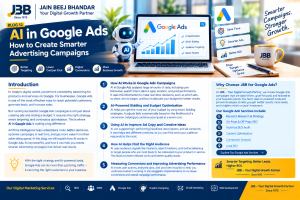
AI in Google Ads: How to Create Smarter Advertising Campaigns
In today’s competitive digital world, businesses need more than advertisements to attract customers. They need the right strategy, the right audience, and the right message at the right time. This is where AI in Google Ads is changing the way businesses advertise online.
Google Ads helps businesses connect with people who are actively searching for products and services. With Artificial Intelligence (AI), advertisers can analyse campaign data, improve targeting, adjust bids, discover new audience opportunities, and make more informed advertising decisions.
However, getting better results from Google Ads is not just about switching on automation. Successful campaigns still need clear goals, relevant keywords, engaging advertisements, accurate conversion tracking, and continuous improvement.
At JBB – Your Digital Growth Partner, we believe that combining smart digital tools with a well-planned marketing strategy can help businesses strengthen their online presence and reach potential customers more effectively. In this guide, we will explore how AI in Google Ads works, its major benefits, and how your business can use it to build smarter advertising campaigns.
What Is AI in Google Ads?
AI in Google Ads refers to the use of Artificial Intelligence and machine learning to analyse information, recognise patterns, make predictions, and automate selected advertising tasks.
Instead of relying entirely on manual decisions, advertisers can use AI-powered features to help manage bidding, identify relevant audiences, generate advertising ideas, and optimise campaign performance.
For example, a business advertising its web development services may want to reach people looking for a professional website. AI-powered advertising features can use available campaign signals to help optimise delivery towards the campaign’s objectives.
AI can support several advertising activities, including:
- Smart bidding to optimise bids for conversion-related goals.
- Audience targeting to help connect advertisements with relevant potential customers.
- Ad creation to generate and test different headlines and descriptions.
- Budget optimisation to help allocate spending towards campaign objectives.
- Performance analysis to identify opportunities for improvement.
AI is a powerful assistant, but it is not a replacement for marketing strategy. The best results come when automation works alongside human expertise, accurate data, and a clear understanding of customer needs.
1. How AI Works in Google Ads Campaigns
AI-powered Google Ads features use available information and machine-learning models to support advertising decisions. Depending on the campaign type and settings, signals may include a user’s search, device, location, time, previous interactions, and the context of an advertising opportunity.
These signals can help Google Ads decide which ad may be relevant, how much to bid for an eligible auction, and how to optimise delivery towards the advertiser’s chosen goal.
How the process works
Step 1: Understand your business goals
Before launching a campaign, decide what you want to achieve. Your objective might be website visits, phone enquiries, product purchases, lead generation, or bookings.
Step 2: Provide relevant campaign information
Advertisers supply information such as keywords or themes, ad copy, landing pages, locations, budgets, and conversion goals, depending on the campaign type.
Step 3: Let AI support campaign decisions
Eligible AI-powered features use available signals to help adjust bids, select suitable ad combinations, or optimise delivery according to the campaign settings.
Step 4: Measure actual results
Conversion tracking and campaign reports help you understand whether your advertising is generating valuable actions rather than simply attracting clicks.
Step 5: Improve the campaign
Use performance data to refine your landing pages, ad messaging, targeting settings, and budget decisions.
For businesses, this process can make campaign management more data-informed and responsive. However, results depend on campaign setup, data quality, competition, budget, and the relevance of the offer.
2. AI-Powered Bidding and Budget Optimisation
Managing advertising costs is one of the biggest challenges for businesses running paid campaigns. A high number of clicks does not automatically mean more customers. What matters is whether those clicks contribute to meaningful business results.
This is where AI-powered bidding in Google Ads can help.
Google Ads offers automated bidding strategies that use contextual signals and predictions to optimise bids towards selected goals. The appropriate strategy depends on whether your priority is conversions, conversion value, clicks, or another supported objective.
Benefits of AI-powered bidding
More goal-focused bidding: Smart Bidding strategies can help optimise bids towards objectives such as conversions or conversion value when correctly configured.
Responsive bid decisions: Automated bidding can adjust bids for individual auctions based on available signals and the chosen strategy.
More efficient campaign management: Automation can reduce the need to manually adjust every bid, allowing marketers to spend more time improving campaign strategy and creative quality.
Support for budget planning: Campaign performance data can help advertisers evaluate how spending relates to leads, sales, and other business outcomes.
How to use your advertising budget wisely
AI cannot make an unsuitable budget profitable by itself. Start with a realistic spending limit and a clear conversion goal. Make sure your website or landing page gives visitors a relevant next step, such as calling your business, submitting an enquiry, or completing a purchase.
Review metrics such as cost per conversion, conversion rate, and conversion value where applicable. Avoid judging performance only by impressions or clicks.
For businesses seeking professional campaign management, JBB’s Google Ads service can help develop a structured advertising strategy focused on relevant traffic, measurable goals, and ongoing optimisation.
3. Using AI to Improve Ad Copy and Creative Ideas
Your advertisement often creates the first impression a potential customer has of your business. Even when targeting is effective, unclear or unappealing ad copy can reduce the likelihood of a useful response.
AI in Google Ads can support the creative process by helping advertisers develop headline ideas, descriptions, messaging variations, and combinations of advertising assets. Depending on the campaign and available features, Google Ads may also provide AI-assisted creative tools.
How AI can help improve advertisements
Generate headline ideas: AI tools can suggest different ways to communicate a product’s value, service benefits, or special offer.
Create message variations: Advertisers can test different messages, such as convenience, quality, affordability, or expertise, to learn what resonates with their audience.
Match messages to customer needs: With clear instructions and accurate information, AI can help adapt messaging to different search intentions.
Save time during brainstorming: AI-generated suggestions can provide a starting point for human review and refinement.
Example: Advertising a digital marketing service
A generic advertisement might say:
“Digital Marketing Services Available.”
A more benefit-focused version could say:
“Grow Your Business Online with Strategic Digital Marketing.”
Another version could focus on a specific service:
“Reach More Potential Customers with Google Ads.”
These are starting points, not guaranteed winning advertisements. Actual performance should be assessed through campaign data, and every claim must accurately represent the service being offered.
Important tips for AI-generated ad copy
- Keep every headline and description relevant to the advertised service.
- Use your target keywords naturally where appropriate.
- Highlight genuine benefits instead of making exaggerated promises.
- Check spelling, grammar, and factual accuracy.
- Follow Google’s advertising policies.
- Review generated text before publishing it.
Creative automation works best when AI supports your ideas rather than replacing your brand’s voice and understanding of its customers.
4. How AI Helps Find the Right Audience
Reaching the right people is essential for advertising success. A campaign may receive plenty of traffic but still perform poorly if the visitors are unlikely to become customers.
AI in Google Ads audience targeting can help optimise campaign delivery using available signals and the targeting options supported by the campaign type.
For example, a business offering website design may want to attract companies looking for a new website, while a local retailer may want to reach potential buyers in its service area.
Ways AI can support audience targeting
Search intent: Search-related signals can help advertising campaigns reach people whose searches indicate an interest in a relevant product or service.
Audience signals: Depending on the campaign, advertisers can provide audience signals or use supported audience segments to help guide optimisation.
Location and device context: Campaign settings and available contextual signals can help advertisers make advertising more relevant to their chosen locations and audiences.
Performance-based optimisation: With suitable conversion measurement, eligible campaigns can optimise delivery towards people or opportunities more likely to support the selected goal.
How to reach a more relevant audience
First, define your ideal customer. Consider what they need, which locations you serve, what problems your product solves, and what action you want them to take.
Next, create relevant ad messaging and direct visitors to a landing page that matches their expectations. Review the search terms and campaign reports available to your account, and use the insights to identify irrelevant traffic or missed opportunities.
Remember that AI targeting does not guarantee that every person who sees an ad will be interested in buying. Your campaign settings, offer, creative, landing page, and conversion data still matter.
5. Measuring Conversions and Improving Advertising Performance
A successful advertising campaign should be evaluated by its contribution to business goals, not simply by how many times an advertisement appears.
AI in Google Ads can support performance optimisation, but reliable measurement is essential. If conversion tracking is incorrect or incomplete, automated systems may optimise towards the wrong signals.
What should you measure?
Click-through rate (CTR): The percentage of ad impressions that result in clicks. It can help you understand how often people click after seeing an ad.
Conversion rate: The percentage of measured interactions that result in a conversion, based on the definition and reporting method used.
Cost per conversion: The advertising cost associated with each recorded conversion.
Return on ad spend (ROAS): The conversion value attributed to advertising divided by advertising spend, where reliable conversion values are available.
Lead quality: Whether enquiries are relevant and have a realistic chance of becoming customers. This may require a CRM or offline conversion data rather than relying only on form submissions.
A practical example
Imagine your business spends ₹10,000 on Google Ads and records 20 enquiries.
The average advertising cost per enquiry is:
₹10,000 ÷ 20 = ₹500 per enquiry.
This gives you a useful starting point, but it does not tell the whole story. If only two enquiries become customers, you should also investigate lead quality, sales follow-up, and the cost of acquiring each customer.
Use conversion tracking carefully, distinguish genuine leads from low-quality submissions, and review performance over a suitable period before making major changes. Not every short-term fluctuation indicates that a campaign needs to be rebuilt.
Keep improving your campaign
- Confirm that conversion tracking works correctly.
- Review the quality of enquiries or sales generated.
- Identify ads and search themes that align with your business goals.
- Improve landing-page content and calls to action.
- Test changes systematically and compare meaningful results.
The goal is not simply to get more clicks. It is to make your advertising more useful, measurable, and aligned with your business objectives.
6. Why Choose JBB for Google Ads and Digital Growth?
Technology alone does not guarantee advertising success. Businesses also need clear planning, relevant messaging, accurate tracking, and consistent optimisation.
At JBB – Your Digital Growth Partner, our digital marketing approach focuses on helping businesses strengthen their online presence with strategies suited to their goals. Our aim is to help you understand your options, make informed marketing decisions, and build a stronger foundation for digital growth.
How JBB can support your business
Google Ads campaign strategy: We can help plan campaigns around your business objectives, target audience, service offering, and available budget.
Keyword and search-intent planning: Relevant keyword research can help connect your advertisements with searches related to your services.
Ad copy and creative direction: Clear messaging and useful creative ideas can help communicate what makes your business valuable.
Campaign monitoring and optimisation: Reviewing campaign data helps identify opportunities to improve performance and address potential issues.
Conversion-focused landing pages: A clear, mobile-friendly landing page can help visitors understand your offer and take the next step.
Connected digital marketing services: Paid advertising can work alongside SEO, social media marketing, graphic design, email marketing, and web development to support a more consistent online presence.
Explore JBB’s Google Ads service to learn more about our advertising offering.
You can also explore our other services:
- Search Engine Optimisation (SEO) – support your organic search visibility.
- Social Media Marketing (SMM) – build your social presence and audience engagement.
- Graphic Designing – create consistent, professional marketing visuals.
- Email Marketing – communicate with customers and nurture relationships.
- Web Development – build a user-friendly website that supports your marketing goals.
These services can complement paid advertising when they are planned around the same business objectives. The right combination depends on your audience, industry, budget, and growth priorities.
Is AI-powered Google Ads right for your business?
AI-powered advertising may be useful for businesses that want to reach relevant customers, measure campaign results, and make better use of available data. However, the right approach depends on your goals and readiness.
Before investing, consider whether you have a clear offer, a suitable landing page, a realistic budget, and a reliable way to measure enquiries or sales. A well-planned campaign is more useful than simply adopting a new technology without a clear objective.
If you want to explore digital marketing for your business, visit the JBB website or contact our team to discuss your requirements.
7. Common Mistakes to Avoid When Using AI in Google Ads
AI can help with campaign management, but poor setup and unrealistic expectations can still waste advertising spend.
Relying entirely on automation: Automated bidding and targeting still need suitable goals, relevant assets, and human oversight.
Using inaccurate conversion data: Incorrect tracking can lead to misleading reports and optimisation towards actions that do not create business value.
Ignoring landing-page quality: A relevant ad cannot compensate for a confusing, slow, or unhelpful website experience.
Making unsupported claims: AI-generated copy must be reviewed for accuracy and compliance with advertising policies.
Changing campaigns too frequently: Frequent major changes can make performance difficult to evaluate. Allow enough time and data for meaningful assessment, while addressing urgent problems promptly.
Measuring clicks instead of business outcomes: Traffic is useful only when it supports your objectives. Track qualified leads, sales, bookings, or other meaningful actions where possible.
Expecting instant results: AI is not a guarantee of lower costs or higher sales. Competition, offer quality, budget, website experience, and customer demand all influence results.
Avoiding these mistakes can help you use automation more thoughtfully and build a stronger advertising process.
Conclusion: Build Smarter Advertising Campaigns with AI
AI in Google Ads is helping advertisers approach campaign management with more automation, data-informed decisions, and opportunities to improve targeting, bidding, creative development, and performance measurement.
But AI works best when it has a clear purpose. Businesses still need relevant keywords, compelling advertising messages, useful landing pages, accurate conversion tracking, and a strategy that reflects their customers’ needs.
For businesses looking to improve their digital presence, combining AI-supported advertising with a broader marketing plan can create opportunities to attract relevant visitors and generate more meaningful enquiries.
At JBB – Your Digital Growth Partner, we believe digital marketing should be planned around real business objectives, not just clicks and impressions. With the right strategy, consistent monitoring, and a focus on measurable outcomes, your business can make more informed advertising decisions and work towards sustainable growth.
Ready to explore smarter advertising for your business? Visit JBB’s Google Ads service and discover how a structured digital marketing approach can support your next stage of growth.
Frequently Asked Questions (FAQs)
1. What is AI in Google Ads?
AI in Google Ads refers to Artificial Intelligence and machine-learning features that support tasks such as automated bidding, ad optimisation, audience targeting, and creative assistance. The available features depend on the campaign type and account settings.
2. Can AI reduce Google Ads costs?
AI-powered bidding can optimise towards selected goals, but it does not guarantee lower costs. Results depend on competition, conversion tracking, campaign setup, landing-page quality, and the value of the offer.
3. Does AI create Google Ads automatically?
Some Google Ads features can assist with generating headlines, descriptions, creative assets, and campaign recommendations. Advertisers should review all generated content for accuracy, brand suitability, and policy compliance.
4. Is AI in Google Ads suitable for small businesses?
Yes, eligible AI-powered features can be useful for small businesses that want to automate selected tasks and make data-informed campaign decisions. The campaign should still have a realistic budget, clear goals, and reliable conversion tracking.
5. What is Smart Bidding in Google Ads?
Smart Bidding is a group of automated bidding strategies that use machine learning to optimise bids for conversion-related goals, such as conversions or conversion value. The right strategy depends on the campaign objective and available data.
6. How can I measure the success of an AI-powered Google Ads campaign?
Measure relevant indicators such as conversion rate, cost per conversion, qualified leads, sales, and return on ad spend where applicable. Accurate tracking and lead-quality assessment are essential for understanding actual business results.
7. Can JBB help my business with Google Ads?
JBB – Your Digital Growth Partner offers digital marketing services, including Google Ads, alongside SEO, SMM, graphic designing, email marketing, and web development. Explore the service pages to find options relevant to your business goals.
Grow smarter with digital marketing. Explore JBB’s digital marketing services and take the next step towards a stronger online presence.
JBB – Your Digital Growth Partner | Since 1975